Atlanta Sprinkler Audit, Catch-Can Test, Fixing Dry Spots, and Setting Run Times for Bermuda, Zoysia, and Tall Fescue
If your Atlanta lawn looks great in some spots and crispy in others, it’s usually not “bad grass.” It’s uneven water. A quick sprinkler audit takes the guesswork out and replaces it with measured numbers you can actually use.
The goal is simple: find out how evenly each zone waters, how fast it applies water (precipitation rate), then set run times that match your grass, soil, slope, and Atlanta’s heat. Think of it like painting a wall, overlap matters. If you miss a strip, you’ll see it.
As of February 2026, Metro Atlanta residential lawn watering is generally allowed year-round only between 4 p.m. and 10 a.m. under Georgia’s statewide watering schedule (always verify current drought status and any local rules or HOA limits before you set a schedule).
What a sprinkler audit checks (and the safety stuff people skip)
A sprinkler audit is a zone-by-zone check of coverage, pressure, and output . You’re looking for three things:
First, head-to-head coverage . In most lawns, each sprinkler should throw water to the next head. If sprays don’t reach, or rotors fall short, you get dry “shadows” that no fertilizer fixes.
Second, matched equipment . Mixed nozzles (different GPM, different arcs, sprays mixed with rotors in the same zone) cause one area to flood while another stays dry. This is a common reason Atlanta lawns get fungus in the low spot and brown spots on the ridge.
Third, runoff vs soak-in , especially with Atlanta clay and sloped yards. Clay can take water slowly. If your zone runs too long, water sheets off the surface and the dry spot shows up downhill from the sprinkler that “seems fine.”
Safety notes that matter:
- Turn the system off at the controller before you pull nozzles or filters.
- Wear eye protection when cleaning nozzles (grit can spray back).
- Watch footing, wet turf on slopes gets slick fast.
- If you’re unsure about your backflow setup, don’t tamper with it, get help.
For a simple, research-based overview of what irrigation auditing measures, see NC State’s irrigation auditing guide.
Catch-can test: measure your precipitation rate (and why “minutes” mean nothing without it)
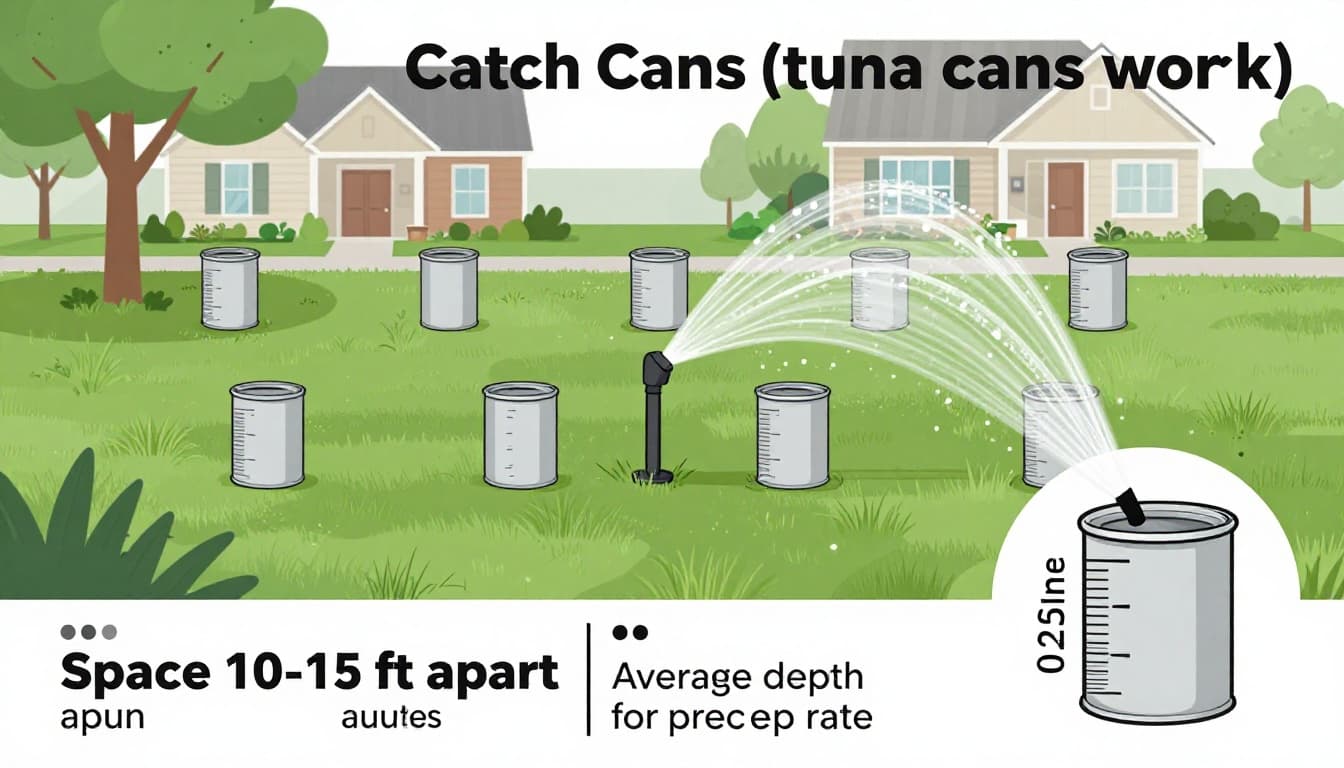 Catch cans laid out in a grid help you see coverage gaps and calculate output, created with AI.
A catch-can test is the fastest way to turn “I run it 20 minutes” into a real number: inches per hour . That number is what you need to set run times for Bermuda, Zoysia, or tall fescue.
Tools (keep it basic):
- 12 to 16 catch cans (tuna cans or straight-sided cups work)
- Ruler with 1/16-inch marks
- Stopwatch or phone timer
- Flathead screwdriver (for arc and spray tweaks)
- Optional: pressure gauge (helpful when a whole zone looks weak)
Steps (one zone at a time):
- Place cans in a grid across the zone, roughly 10 to 15 feet apart (or evenly spaced to match the zone shape).
- Run the zone for 15 minutes .
- Measure water depth in each can (in inches) and write it down.
- Calculate the average depth (add them up, divide by number of cans).
- Convert to precipitation rate:
Precip rate (in/hr) = (Average inches × 60) ÷ minutes run
Sample calculation: if your average can depth is 0.25 inch
after 15 minutes
, then
(0.25 × 60) ÷ 15 = 1.0 in/hr
.
Also glance at uniformity. If some cans are near zero while others are double, that zone will always produce dry spots until coverage is fixed. For a deeper walkthrough of the method, use NMSU’s catch-can audit instructions.
Fixing dry spots and setting run times for Bermuda, Zoysia, and tall fescue
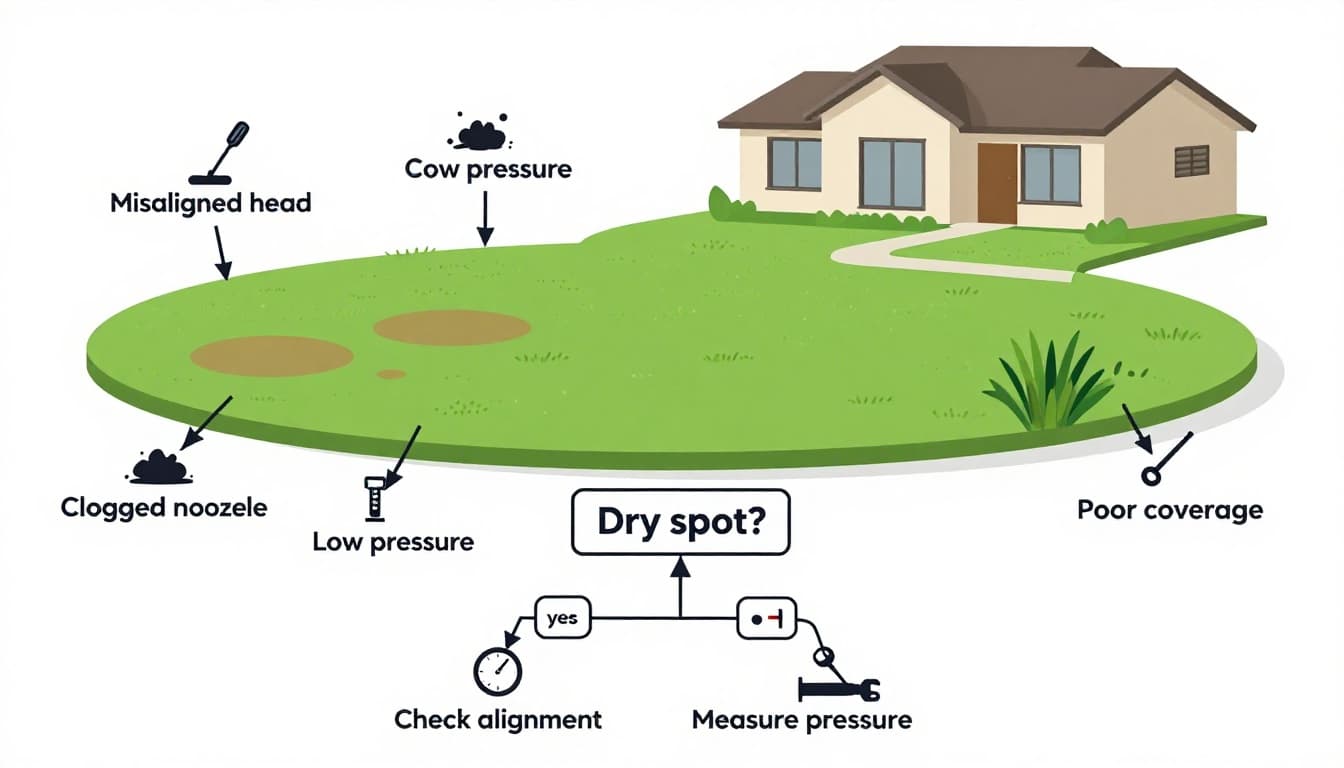 Common sprinkler-caused dry spots and a simple troubleshooting flow, created with AI.
A practical dry-spot decision tree (fast checks first)
Use this quick path before you add more minutes:
- Dry spot near one head?
Check alignment and arc first. A small bump from a mower can turn a head 10 degrees and starve a strip. - Head sprays weak or dribbles?
Clean the nozzle and filter. If the whole zone looks weak, suspect low pressure or a partially closed valve. - Dry spot between heads?
You likely lack head-to-head coverage. Fix with nozzle selection, spacing changes, or adding a head (often the real solution). - Area stays dry even with good coverage?
Probe the soil with a screwdriver. If it’s hard and dry an inch down, you may have compaction or dry, water-repellent soil. Aeration and cycle-and-soak help. - Spot is brown but soil is wet?
That’s usually not irrigation. It can be fungus, insects, or pet urine. For common brown-patch causes to rule out, see Rain Bird’s brown patch breakdown.
Weekly inches (then convert to minutes using your measured rate)
These are starting ranges for established lawns. Always subtract rainfall, and stay inside watering-hour rules.
| Grass type | Winter (Dec to Feb) | Spring (Mar to May) | Summer (Jun to Aug) |
|---|---|---|---|
| Bermuda | 0 to 0.5 inch every 3 to 4 weeks if dry | ~1.0 inch/week | 1.0 to 1.5 inches/week |
| Zoysia | 0 to 0.5 inch every 3 to 4 weeks if dry | ~1.0 inch/week | 1.0 to 1.5 inches/week |
| Tall fescue | ~0.5 inch every 10 to 14 days if dry | 1.0 to 1.5 inches/week | 1.0 to 2.0 inches/week (heat stress risk) |
Tall fescue note for Atlanta: it has a shorter root depth and struggles in long heat waves. Even with perfect watering, summer quality may dip. Many homeowners aim to keep it alive, not perfect, then re-seed in fall.
For Bermuda seasonal habits and stress timing, Texas A and M’s Bermudagrass calendar is a solid reference.
Turn inches into run times, then use cycle-and-soak for clay and slopes
Once you know your zone’s precipitation rate, the math is quick:
Weekly minutes per zone = (Target inches/week ÷ precip rate in/hr) × 60
Example: Your catch-can test shows 0.8 in/hr
on a rotor zone. You want 1.2 inches/week
for Bermuda in July.
(1.2 ÷ 0.8) × 60 = 90 minutes per week
on that zone.
Now split those minutes so water can soak in:
- Atlanta clay, flat yard : try 2 days/week, 2 cycles of 12 to 15 minutes each day (soak 30 to 60 minutes between cycles).
- Atlanta clay, slope : try 2 to 3 days/week, 3 × 8 minutes (instead of 1 × 24 minutes). If you see runoff, shorten cycles and add one more.
Quick rule: if you see water moving across the surface, you’ve passed the soil’s intake rate. More minutes won’t help the dry spot, it just sends water away from it.
Conclusion
A sprinkler audit isn’t about watering more, it’s about watering evenly . Measure your precipitation rate with a catch-can test, fix coverage problems that create dry shadows, then set run times based on inches, not habit. If you’re consistent with cycle-and-soak on Atlanta clay, Bermuda and Zoysia will reward you, and tall fescue has a better shot at making it through summer. The next time you see a dry spot, don’t guess, test and adjust.