Leyland Cypress Canker in Atlanta Privacy Screens
A browning Leyland cypress screen can go from green to ugly faster than many Atlanta homeowners expect. Warm rain, crowded rows, and heavy clay soil can turn a privacy hedge into a patchwork of dead tips and bare gaps.
The hard part is sorting out stress from disease. Leyland cypress canker is often part of the problem, but it is not the only one, and the right fix depends on how far the damage has spread.
How browning shows up on Leyland cypress
Not every brown branch means a canker problem. Leyland cypress can also brown from drought stress, poor drainage, root damage, bagworms, or plain old crowding.
The clue is in the pattern. Canker damage usually starts on a branch or stem, then spreads along that wood. Needles may brown on one side first, while nearby shoots stay green for a while.
Here is a simple way to read what you are seeing:
| What you see | What it often suggests | What to do next |
|---|---|---|
| Brown needles mostly inside the hedge | Normal inner shedding or light stress | Check watering, spacing, and airflow |
| Scattered brown branch tips | Possible twig blight or early canker | Inspect stems closely and prune damaged tips |
| One dead limb on an otherwise green tree | Localized injury or canker | Cut back to healthy wood |
| Sunken bark, resin, or trunk dieback | Serious canker or root trouble | Get a professional look, consider removal |
The main takeaway is simple. Color alone does not tell the full story. You need to look at the stems and bark, not just the needles.
Several canker diseases can affect Leyland cypress, and they can look alike from the ground. That is why a quick glance from the driveway is often misleading.
If the bark is still intact and the damage stays on a few branches, the tree may be worth saving. If the trunk is involved, the outlook changes fast.
What Leyland cypress canker looks like up close
A canker is a dead, damaged area on bark or stem tissue. On Leyland cypress, it often shows up as a sunken or cracked patch, sometimes with resin or a darkened edge.
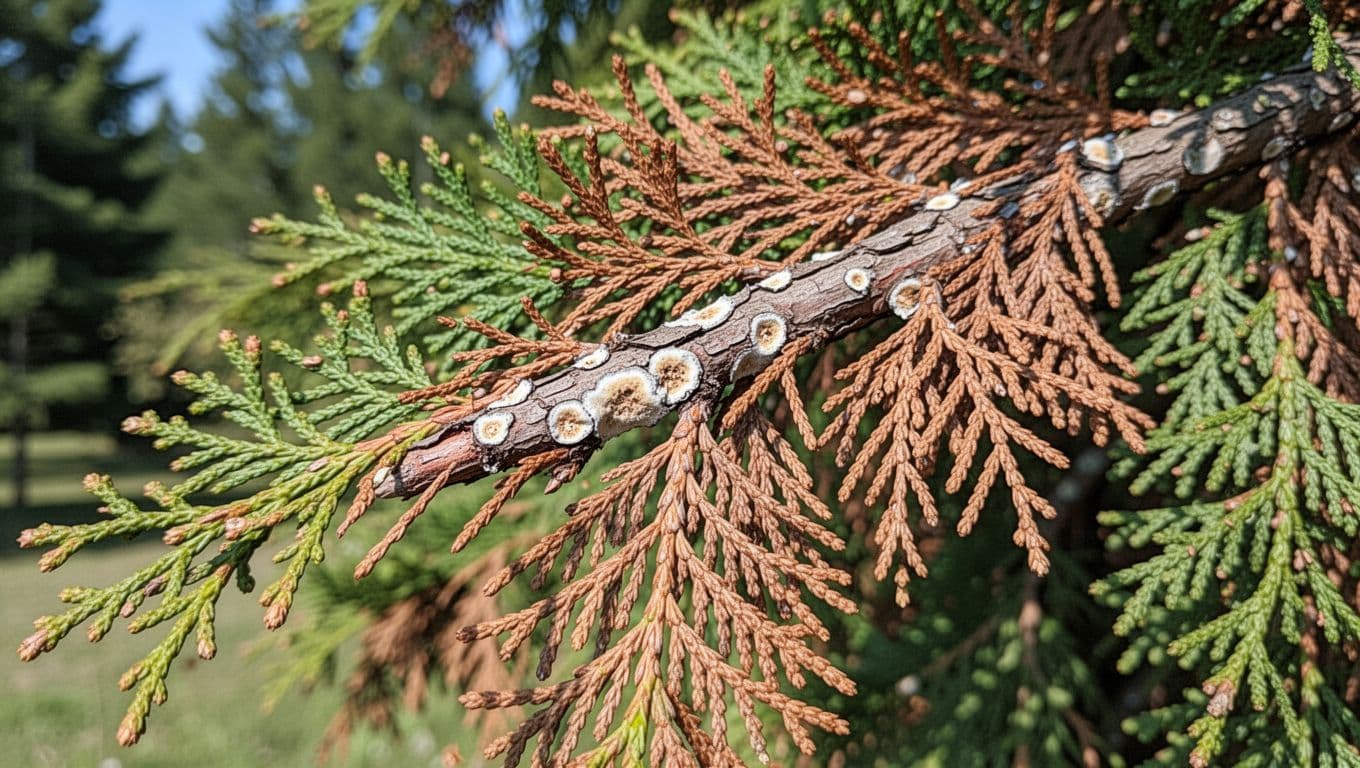
Look at where the browning begins. If it starts at a branch tip and moves inward, pruning may help. If it starts lower on the limb or on the main stem, the disease may already be inside the wood.
Also watch for repeating dead spots. When one section dies, then another section dies a few months later, the tree is usually under steady stress. In Atlanta, that stress often comes from wet roots after storms, then dry stretches, then heavy pruning, then another round of moisture.
Wounds make things worse. String trimmers, mowers, and overzealous shearing cuts create openings that invite infection. A screen planted too tightly along a fence line also traps humidity, and that moisture lingers on the bark.
A single brown branch can be dealt with. A trunk that shows canker damage is a different story.
Prune, monitor, or remove the tree
This is where many privacy screens are saved, or lost. The right move depends on how much healthy wood is left.
| Situation | Best move | Outlook |
|---|---|---|
| A few infected outer branches | Selective pruning | Often workable |
| Several scattered limbs, trunk still clean | Prune and monitor | Fair, if the tree stays vigorous |
| Trunk lesions or girdling cankers | Removal | Usually the practical choice |
| More than about half the screen is brown | Replace the row | Recovery is unlikely |
Selective pruning helps when the problem stays limited. Cut infected branches back into healthy wood, and make the cut well below the visible damage. Clean tools between cuts so you do not drag disease from branch to branch.
Prune on a dry day if you can. Atlanta humidity does not help wounds dry fast, so avoid unnecessary cuts during a wet stretch. A thinning cut is better than a hard shear, because the goal is to keep the canopy healthy, not to buzz it into a flat wall.
When the trunk has a canker, the math changes. If the main stem is affected, the tree has lost the wood it needs to move water and nutrients. No amount of trimming will rebuild that tissue.
The same is true when the canopy is mostly gone. A row that has lost its job as a screen rarely fills back in evenly. You may get a few green shoots, but the hedge will still look thin and tired.
For property managers, that matters. A partial fix can buy time on a small section of fence line. It does not solve a row that is failing from end to end.
Atlanta weather and care habits that make canker worse
Atlanta's weather puts Leyland cypress under pressure. Hot, humid summers keep foliage wet. Heavy clay soil holds water after storms. Then a dry spell can hit right after, and the tree swings from too wet to too dry.
That stress matters because stressed trees get attacked more easily. A healthy screen can shrug off minor damage. A stressed screen gives canker diseases a better entry point.
A few care habits make a real difference:
- Water deeply, then let the soil breathe before the next irrigation.
- Keep mulch around the base, but pull it back from the trunk.
- Avoid overhead watering that keeps branches wet into the evening.
- Skip aggressive shearing, especially on already thin screens.
- Protect trunks from mower and trimmer damage.
- Leave enough space for air to move through the row.
- Inspect the hedge after long rain periods and after summer storms.
The mulch ring deserves special attention. A pile of mulch pressed against the trunk holds moisture where you do not want it. That soft, damp area is an easy target for disease.
Spacing matters too. A privacy screen planted too tightly can look good for one season, then start losing lower branches because light and air never reach the interior. Once that happens, the hedge becomes a wall on the outside and bare on the inside.
If you are managing a commercial property, schedule quick walk-throughs during the growing season. You do not need a full tree survey every time. You do need to catch browning early, before the problem reaches the trunk.
Better screening choices when a row is beyond saving
Sometimes the honest answer is removal. If the Leyland cypress row is full of trunk cankers, major dieback, or repeated branch loss, replacement is often smarter than another round of pruning.
That is also the time to rethink the planting choice. Before you put in another wall of the same tree, compare best evergreen hedges for Georgia landscapes that fit clay soil and Atlanta heat better.
A mixed screen often works better than a single species hedge. Hollies, viburnum, cherry laurel, and other dense evergreens can give you privacy without putting every plant at the same risk. If one shrub struggles, the whole line does not collapse at once.
Site prep matters here as much as plant choice. If drainage is poor, fix that first. If roots stay wet after a storm, even a good replacement plant will struggle.
Replacement also gives you a chance to reset spacing. A screen with a little breathing room is easier to maintain, and it usually stays healthier longer. The goal is not just to block a view this year. It is to avoid repeating the same failure in three years.
Conclusion
Brown Leyland cypress branches in Atlanta do not always mean the screen is finished. They do mean the hedge needs a closer look, because canker diseases often hide in the bark long before the whole row turns brown.
The key decision is simple. Selective pruning can help when the damage stays on a few branches and the trunk still looks sound. Full removal is the more practical choice when the canker reaches the main stem or the screen has already lost too much green growth.
A quick diagnosis, a realistic plan, and the right follow-up care can save time and money. When a privacy screen starts browning, the best answer is the one that fits how far the problem has already spread.