Atlanta Landscape Lighting Cost Guide for 2026
A professional lighting system can make an Atlanta yard safer, more useful, and easier to enjoy after dark. If you're researching Atlanta landscape lighting cost , plan on roughly $2,000 to $6,000 for a typical professionally installed system in 2026.
Small projects may start around $800, while larger custom installations can exceed $10,000. The final price depends on fixture count, product quality, wiring distance, transformer capacity, property layout, and any electrical work.
Atlanta landscape lighting cost in 2026: realistic ranges
Most Atlanta homeowners fall into one of three budget categories. The table below provides a practical starting point for planning.
| Project size | Typical 2026 cost | What it may include |
|---|---|---|
| Small or basic system | $800 to $1,500 | Four to eight fixtures, a short wire run, and simple controls |
| Typical professional installation | $2,000 to $6,000 | Eight to 20 fixtures, mixed lighting zones, transformer, wiring, and installation |
| Large custom system | $7,000 to $10,000+ | Many fixtures, long wire runs, specialty lighting, multiple zones, or commercial-scale work |
Atlanta-specific pricing guides report installed costs of about $209 to $335 per fixture . That figure includes estimated materials of $92 to $148, labor of $75 to $121, supplies of $25 to $39, and equipment or disposal costs of $16 to $26 per fixture.
Pathway lighting can begin around $150 per fixture installed, depending on the product and installation conditions. Local published starting points also vary, with Maxwell Landscape Construction listing projects starting at $2,500 and Illuminating Design listing residential systems starting at $3,000.
These figures don't conflict with the lower $800 estimate. A small system may use fewer fixtures and require less trenching. A complete front-yard and backyard design needs more equipment, wiring, setup, and testing.
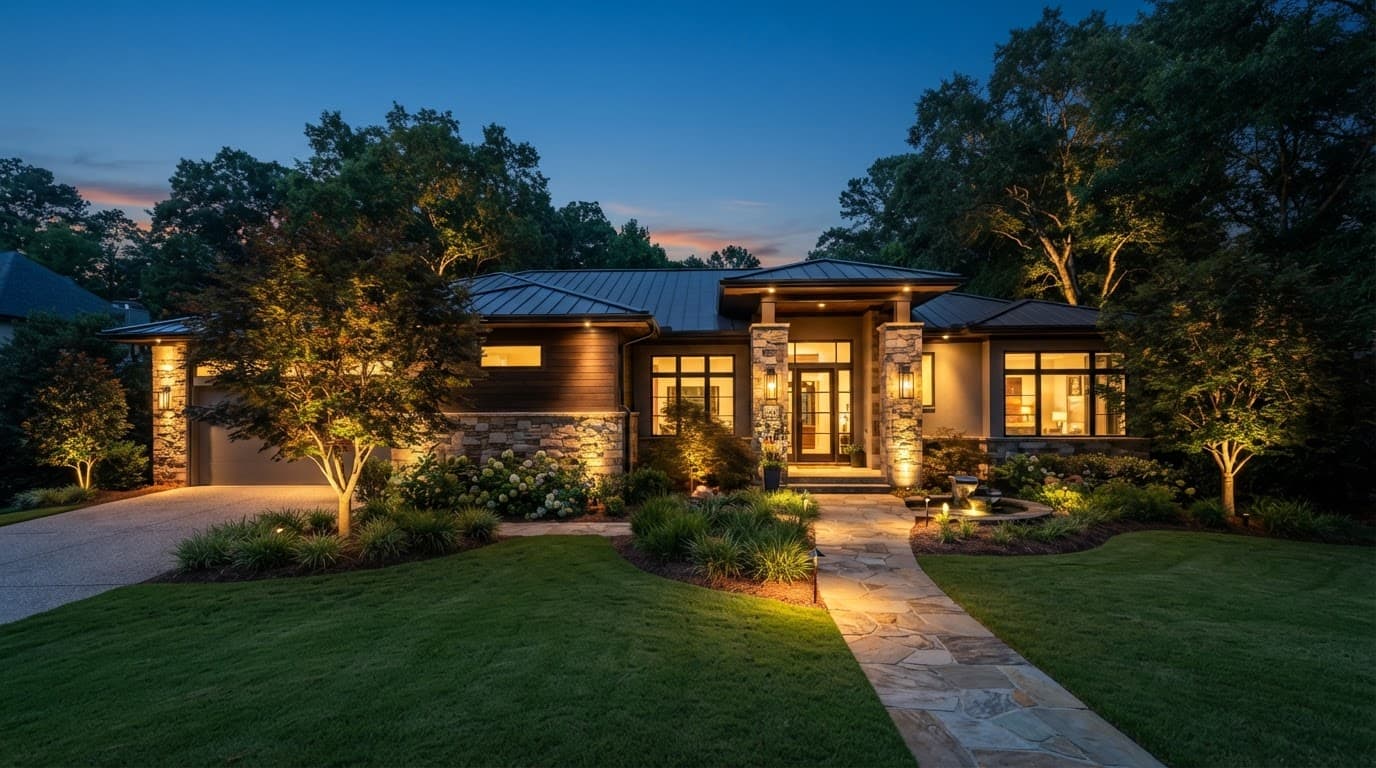
Well-placed lighting can highlight trees, walkways, stonework, and the home's architecture without making the yard look overly bright.
What a professional lighting installation usually includes
A complete quote should cover more than the visible fixtures. Reliable installation also depends on the transformer, wire layout, connectors, timers, and careful placement.
Most professional proposals include:
- A basic lighting plan that identifies paths, steps, trees, walls, entries, and entertaining areas.
- Low-voltage LED fixtures selected for brightness, beam spread, finish, and weather exposure.
- Direct-burial cable, waterproof connectors, and protective sleeves where needed.
- A transformer sized for the system's total wattage.
- Trenching, fixture placement, aiming, testing, and cleanup.
- A timer, photocell, or smart control system for automatic operation.
The per-fixture estimate can help you understand how an installer builds a price.
| Cost component | Atlanta planning range per fixture | What affects it |
|---|---|---|
| Materials | $92 to $148 | Fixture quality, wire, connectors, and mounting hardware |
| Labor | $75 to $121 | Digging, routing wire, placement, aiming, and testing |
| Supplies | $25 to $39 | Small materials, protection, and installation accessories |
| Equipment and disposal | $16 to $26 | Tools, hauling, and job-site handling |
| Estimated installed total | $209 to $335 | Combined project components |
For example, 12 fixtures at the Atlanta per-fixture range would produce a rough planning figure of $2,508 to $4,020. A contractor may quote more or less after reviewing the property because whole-project pricing doesn't always follow a strict per-light formula.
Ask whether the quote includes repairing disturbed mulch, turf, or planting beds. Those details can affect the final Atlanta landscape lighting cost, especially when crews need to cross established lawn areas.
The property details that change your quote
Two homes with the same number of fixtures can have very different installation costs. The difference usually comes from access, wire distance, and the amount of work needed below the surface.
Fixture count and lighting design
More fixtures usually increase the equipment and labor budget, but placement matters just as much. Six well-aimed lights may produce a better result than 12 fixtures pointed randomly at the house.
Path lights help define walkways and steps. Uplights bring attention to trees, columns, brick, and stone. Downlights can cast light through branches, while wall washes provide broader coverage across a surface.
Your installer should discuss brightness, beam spread, color temperature, glare, and spacing. Lights that shine directly into windows or a neighbor's yard may need repositioning. A thoughtful plan improves the appearance while limiting unnecessary fixture purchases.
Wiring distance, slopes, and access
The transformer location affects how much cable the crew needs. A front entry close to the electrical source costs less to wire than a backyard patio separated by a long lawn, retaining wall, or driveway.
Atlanta properties often include slopes, mature root systems, red clay, stone edging, and dense planting beds. Each condition can slow trenching or require a different installation method. Pavers and concrete also raise costs because crews may need special cutting, boring, or surface restoration.
Long wire runs can create voltage drop. The installer may need heavier-gauge cable, separate runs, or multiple zones to maintain even light output.
Transformer capacity and electrical upgrades
A transformer converts household power for a low-voltage lighting system. It must have enough capacity for the connected fixtures, controls, and future additions.
If your existing outdoor outlet is in good condition, the project may need no major electrical work. However, an electrician may need to add a GFCI-protected outlet, correct unsafe wiring, repair a damaged circuit, or upgrade the panel. Those tasks are separate cost factors.
Before approving a quote, ask whether the transformer has room for future fixtures. Planning for expansion now can prevent another installation charge later.
Choosing fixtures and controls for an Atlanta home
Low-voltage LED systems are common for residential landscape lighting because they use less energy and offer flexible placement. They also make it easier to create separate zones around an entry, driveway, patio, or garden.
Aluminum fixtures usually cost less upfront. Brass and copper fixtures often cost more but can offer a heavier build and a different aging pattern. Ask about the fixture warranty, finish warranty, replacement parts, and protection against moisture.
Pathway fixtures are useful along sidewalks, driveways, and steps. Local Atlanta pricing starts around $150 per pathway fixture, although the actual figure depends on trenching and product selection. Accent fixtures generally fall within the broader installed range of $209 to $335 per fixture when materials and labor are included.
Solar fixtures may reduce wiring work, but they depend on direct sunlight and battery performance. Shade from trees or the home's orientation can limit their output. For consistent brightness, a professionally wired low-voltage system is usually easier to control.
Timers and photocells keep the system automatic. Smart controls can add convenience, but they also add equipment and setup costs. Ask for the control equipment as a separate line item so you can compare basic and upgraded options.
How to compare Atlanta lighting quotes
A low total price doesn't tell you much if one proposal includes fewer fixtures or less site work. Compare the scope before comparing the totals.
- Check the fixture schedule. The quote should list the number, type, finish, wattage, and intended location of each fixture.
- Review the installation work. Look for trenching, wire length, transformer size, connectors, controls, testing, cleanup, and surface restoration.
- Ask about electrical changes. Confirm whether the price includes a new outlet, GFCI protection, panel work, or an electrician's separate visit.
- Compare warranties and follow-up service. Find out who handles failed fixtures, loose connections, transformer issues, and seasonal adjustments.
- Request a site-specific proposal. Online estimates can't account for slopes, roots, pavers, existing wiring, or long runs across the property.
If the lighting project also involves reshaping beds, adding mulch, or improving planting areas, coordinate the work with your broader residential landscaping services. Completing related outdoor work together may reduce duplicate visits and protect newly installed wiring.
Ways to control Atlanta landscape lighting cost
You can lower the project budget without making the yard feel unfinished. Start with the areas that improve safety and visibility, then add decorative zones later.
Focus the first phase on the front walk, steps, driveway edges, entry door, and one or two major trees. These areas provide noticeable results with fewer fixtures.
Choose LED fixtures with a properly sized transformer. Avoid buying the cheapest products if replacement parts and warranty support are unclear. A failed fixture can become expensive when the system requires repeated troubleshooting.
Ask the contractor to price the work in phases. A future-ready transformer and accessible wire layout can make a second phase easier. However, don't pay for oversized equipment without a clear reason.
You can also coordinate lighting with planting-bed work or a mulch refresh. See this Atlanta mulch installation cost guide when estimating related improvements.
Finally, keep the surrounding lawn trimmed and edges defined. Overgrown grass can hide path lights, cover fixtures, and make a well-designed system appear uneven. Regular residential lawn care and mowing helps protect the finished appearance.
Conclusion
For most Atlanta homeowners, a realistic 2026 lighting budget is $2,000 to $6,000 . Small systems may cost less, while large custom designs can reach $7,000 to $10,000 or more.
The most accurate Atlanta landscape lighting cost comes from a site-specific quote that lists fixtures, wiring, transformer capacity, electrical work, controls, and cleanup. When those details are clear, you can compare proposals fairly and build a lighting system that fits both your yard and your budget.