Atlanta Lawn Leveling Cost Guide for 2026
A simple lawn-leveling job in Atlanta can cost a few hundred dollars or several thousand, and the gap usually comes down to slope, drainage, and how much soil has to move. In a city with heavy clay, summer downpours, and lots of warm-season turf, the bill can change fast.
If your yard has low spots, puddles, or bumps that catch the mower, you need a price that makes sense for your property, not a national average pulled from somewhere else. This guide breaks down Atlanta lawn leveling cost in 2026 so you can compare quotes with a sharper eye.
Key Takeaways
- Most Atlanta yard-leveling projects land between $1,285 and $4,170 , with a typical job around $2,719 .
- Small spot fixes cost less, while full-yard leveling, access problems, and extra fill raise the price.
- Clay-heavy soil, slope, runoff, and compacted ground matter more in Atlanta than many homeowners expect.
- If water pools near the house or runs the wrong direction, leveling alone may not be enough.
What Atlanta Lawn Leveling Costs in 2026
For most homeowners, the first question is simple: what does this actually cost? Recent 2026 Atlanta estimates put typical lawn leveling work around $2,719 , with many jobs falling between $1,285 and $4,170 . Small repairs can start around $500 to $1,500 , while larger or more complicated yards can reach $3,500 to $7,000 .
The price usually comes from labor, fill material, and how hard the crew has to work to move that material. Hourly labor often runs $40 to $80 for landscape regrading, while general labor with equipment can land around $25 to $50 per hour . Fill material varies even more, with common ranges from $65 to $395 per cubic yard depending on the soil blend and delivery setup.
Here is a quick snapshot of common pricing pieces:
| Cost item | Typical Atlanta range |
|---|---|
| Labor for regrading | $40 to $80 per hour |
| General labor with equipment | $25 to $50 per hour |
| Fill material | $65 to $395 per cubic yard |
| Per square foot | $0.08 to $2.00 |
A small 1,000 square foot area can still range widely, from about $770 to $3,000 , because one yard may need only light topdressing while another needs real correction. A 10,000 square foot yard often lands around $2,500 to $2,900 , and 15,000 square feet can climb to $3,750 to $4,350 .
The takeaway is straightforward. Two yards that look similar from the street can produce very different quotes once the crew measures slope, drainage, and access.
Why Atlanta Yards Cost More or Less
Atlanta's clay-heavy soil changes the job. Clay compacts hard, drains slowly, and holds water after a rain. That means a low spot can stay soggy longer, and a minor dip can become a muddy patch that keeps spreading.
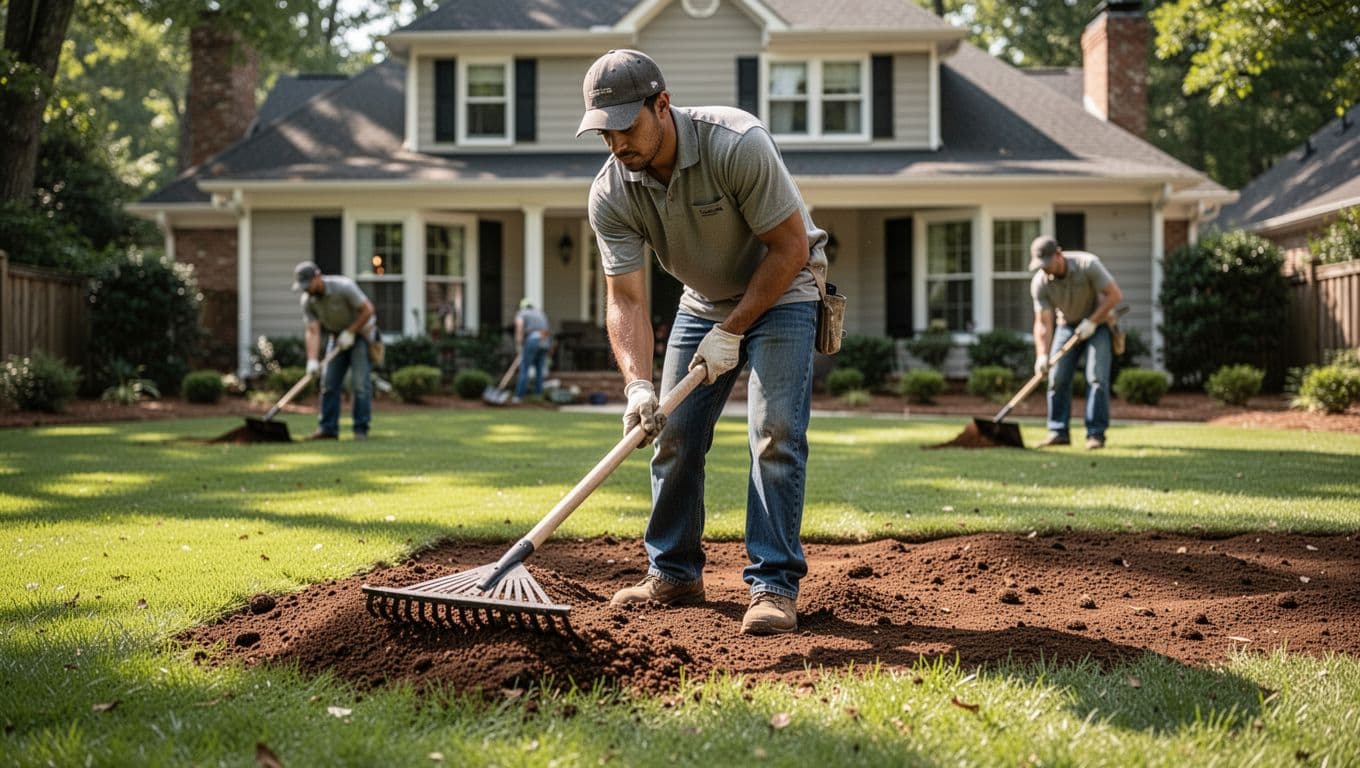
Warm-season grasses also shape the work. Bermuda, zoysia, and centipede lawns are common around metro Atlanta, and each one reacts differently to added soil, compaction, and recovery time. A leveling project that leaves a bermuda lawn ready to spread may still stress a slower area of zoysia if the surface was cut too aggressively.
Slope is another big factor. A yard with a gentle crown is one thing. A yard that sends runoff toward a patio, driveway, or foundation is another. Once the crew has to redirect water, not just smooth turf, the job needs more planning and more labor.
Access matters too. If equipment can't reach the work area easily, the crew may have to move soil by hand or with smaller machines. Tight side yards, fences, steep back entries, and dense tree cover all add time. The same goes for roots, old sod, buried debris, and thin topsoil.
Rainfall plays a role as well. Atlanta gets enough heavy rain to expose bad drainage fast, so a yard that looks fine in dry weather may show its real problems after one storm. That is when soft spots, exposed roots, and erosion lines start to show.
When Leveling Is Enough, and When Grading Is Smarter
Light lawn leveling works best when the problem is mostly cosmetic or shallow. Small bumps, mower scalps, and a few low spots often respond well to topdressing and careful smoothing. If the grade around the home is already sound, this kind of work can improve the lawn without turning into a bigger construction project.
The picture changes when water has a place to collect. If puddles hang around after rain, mulch washes away, or runoff heads toward the house, the issue is usually bigger than surface leveling. In that case, the slope itself may need correction, and drainage features may need to join the plan.
If water sits near the foundation or moves the wrong way across the yard, leveling alone usually won't solve the problem.
That is where residential grading and paving services can make more sense than a simple soil pass. Grading reshapes the land so water moves away from structures, while related drainage work handles the flow after it leaves the surface.
A good rule is to match the fix to the symptom. If the turf is uneven but the water moves well, leveling may be enough. If the yard is uneven and the water moves badly, the job needs more than a rake and a load of fill.
DIY vs Hiring a Pro in Metro Atlanta
A homeowner can handle very small spots with the right tools, some time, and patience. A shovel, rake, wheelbarrow, and tamper can work for a shallow dip near a walk or patio. The problem is that a small mistake in slope can send water the wrong direction, and then the repair gets more expensive.
Professional work makes more sense when the yard has multiple low spots, a big slope change, or a drainage issue. A crew can measure the grade, choose the right fill, compact it properly, and blend the new surface into the old lawn. That matters with Atlanta clay, because loose fill on top of hard soil can settle unevenly if it is not handled well.
If you are asking for quotes, keep the conversation specific. Ask how many square feet they plan to level, what type of fill they will use, and whether cleanup and compacting are included. Also ask whether they expect to spot-seed, lay sod, or come back for touch-ups after the soil settles.
A few details are worth putting in writing before work starts:
- The exact area they measured.
- The fill material they plan to bring.
- Whether haul-away and cleanup are included.
- Whether the quote covers drainage correction or only surface leveling.
If you want the leveling job tied into broader yard care, Atlanta residential lawn maintenance can help you bundle mowing, mulch, and seasonal cleanups with the repair work. That approach often keeps the yard looking finished instead of half-done.
The cheapest quote is not always the best deal. If one estimate leaves out soil, compaction, or drainage corrections, the final price can rise later.
Conclusion
Atlanta lawn leveling in 2026 is all about the condition of the yard, not just its size. Clay soil, slope, runoff, and access can turn a modest repair into a bigger project fast.
If your problem is a few shallow low spots, leveling may be enough. If water pools near the house or the ground keeps shifting, grading or drainage work may be the better fix. A solid quote should explain that difference clearly, because the right repair is the one that matches the land .