Atlanta Nutsedge Control Guide (yellow vs purple), best spray windows, what won’t work, and how to stop re-sprouts
Nutsedge has a way of making a good lawn look messy overnight. You mow on Saturday, and by Tuesday those bright green shoots are back, standing taller than your turf like little flags.
If you want Atlanta nutsedge control that actually sticks, you need two things: the right ID (yellow vs purple), and the right timing. Nutsedge isn’t a “regular weed” because it stores energy underground, then re-sprouts when the top gets stressed or cut.
This guide breaks down how to tell what you’ve got, when to spray in Metro Atlanta, what products and habits usually disappoint, and how to keep new shoots from returning.
Yellow vs purple nutsedge in Atlanta, how to tell which one you have
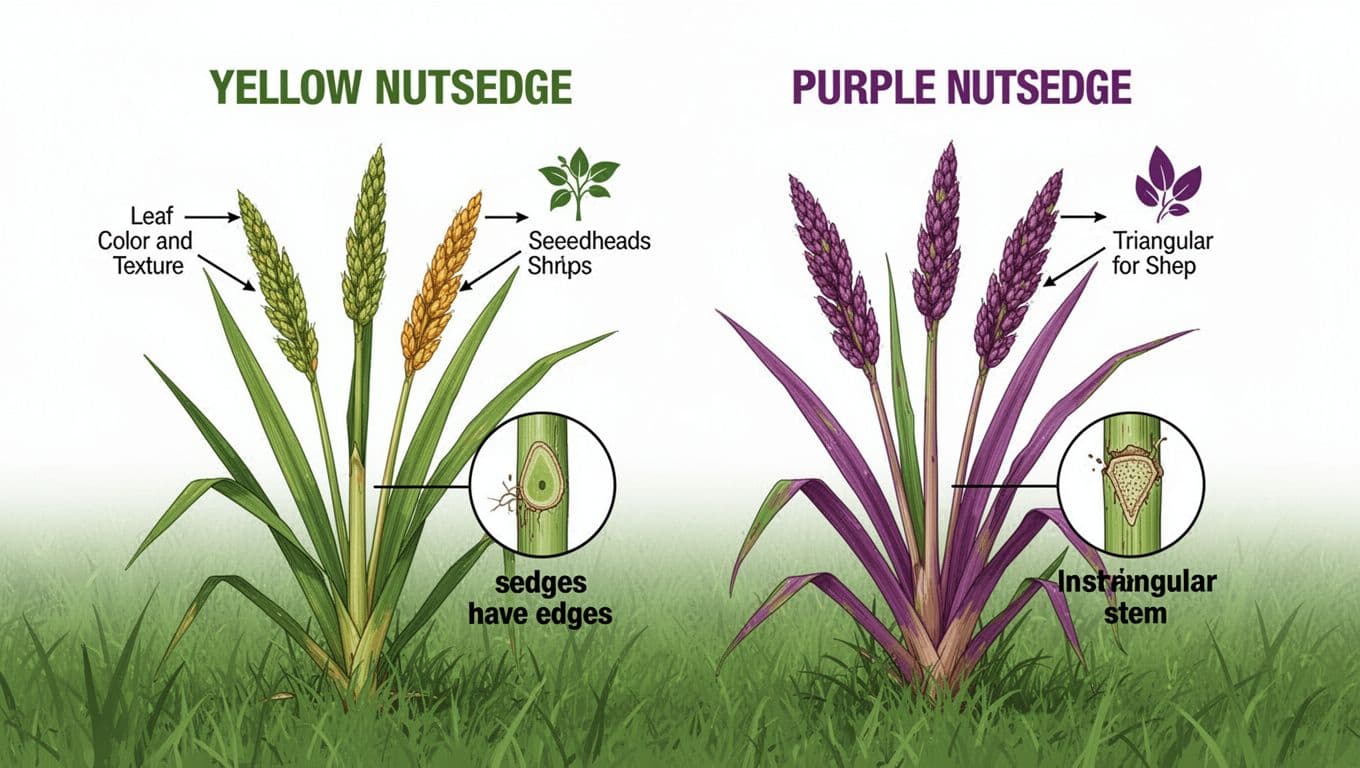 Side-by-side ID cues for yellow vs purple nutsedge, plus the triangular stem reminder, created with AI.
At a glance, nutsedge looks like grass that’s had too much coffee. The giveaway is the stem. Roll it between your fingers, and you’ll often feel a triangular edge (the old line is “sedges have edges”).
Yellow and purple nutsedge both show up in Atlanta lawns, especially in areas that stay damp or compacted. Correct ID matters because some treatment plans work better when the plant is actively growing, and purple nutsedge can be more stubborn due to its underground growth habit.
Here’s a quick homeowner-friendly comparison:
| Feature | Yellow nutsedge | Purple nutsedge |
|---|---|---|
| Leaf color | Yellow-green, bright | Darker green, sometimes glossy |
| Growth habit | Upright, fast in summer | Often denser, can form tight patches |
| Seedhead (if unmowed) | Golden to straw colored | Reddish-purple to dark |
| Underground tendency | Tubers (nutlets) form later | Heavy rhizomes and tubers, spreads aggressively |
If you want deeper biology and photos for confirmation, the University of Florida IFAS has a solid reference on yellow and purple nutsedge biology and management.
Do this first: the action checklist that prevents repeat failures
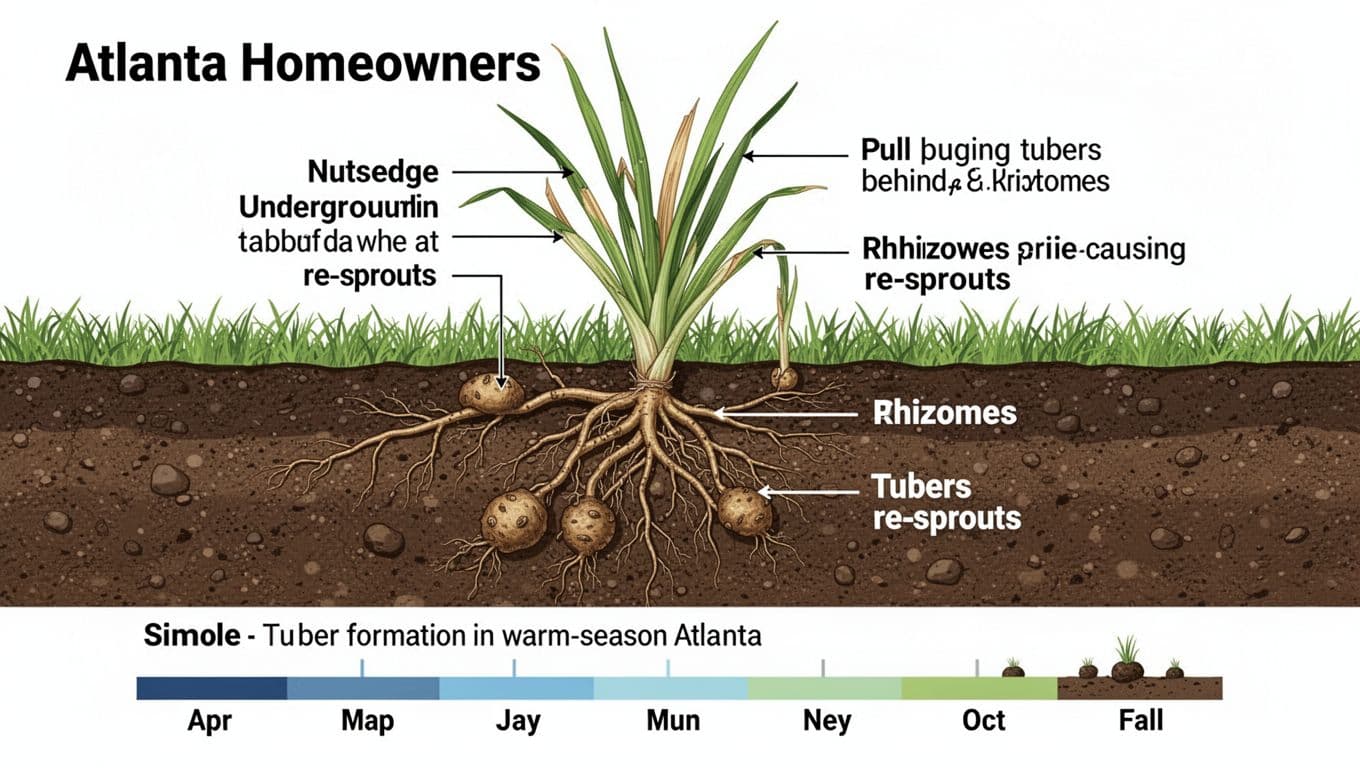 How nutsedge stores energy underground (and why it re-sprouts after pulling), created with AI.
If nutsedge keeps coming back, it’s usually because the underground “battery” is still charged. Nutsedge spreads with rhizomes (underground stems) and forms tubers (nutlets). Those tubers can sit in the soil and send up new shoots later, even if the top looks dead.
Before you spray anything, run this quick checklist:
- Confirm it’s nutsedge : Triangular stem, shiny leaves, and shoots that outgrow the lawn between mows.
- Stop hand-pulling : Pulling often snaps stems and leaves tubers behind, which can trigger more shoots.
- Water smart : Overwatering feeds nutsedge. In summer, irrigate deeply but less often, and fix chronic soggy spots.
- Mow correctly : Scalp-stressed turf invites sedge. Use your grass’s recommended height and avoid mowing right around spray day (more on timing below). This Atlanta mowing height guide for Bermuda, Zoysia, and Tall Fescue helps you set a realistic height that keeps turf dense.
- Plan on repeat applications : One spray is rarely the finish line. Think “series,” not “single shot.”
- Protect sensitive areas : Mark vegetable beds, ornamentals, and storm drains so you don’t drift or rinse product where it shouldn’t go.
If nutsedge is breaking through in the same low area every year, treat the cause too. Compacted clay, downspout discharge, thin turf, and poor drainage are basically a welcome mat.
Best spray windows in Atlanta (and how to time mowing, rain, and heat)
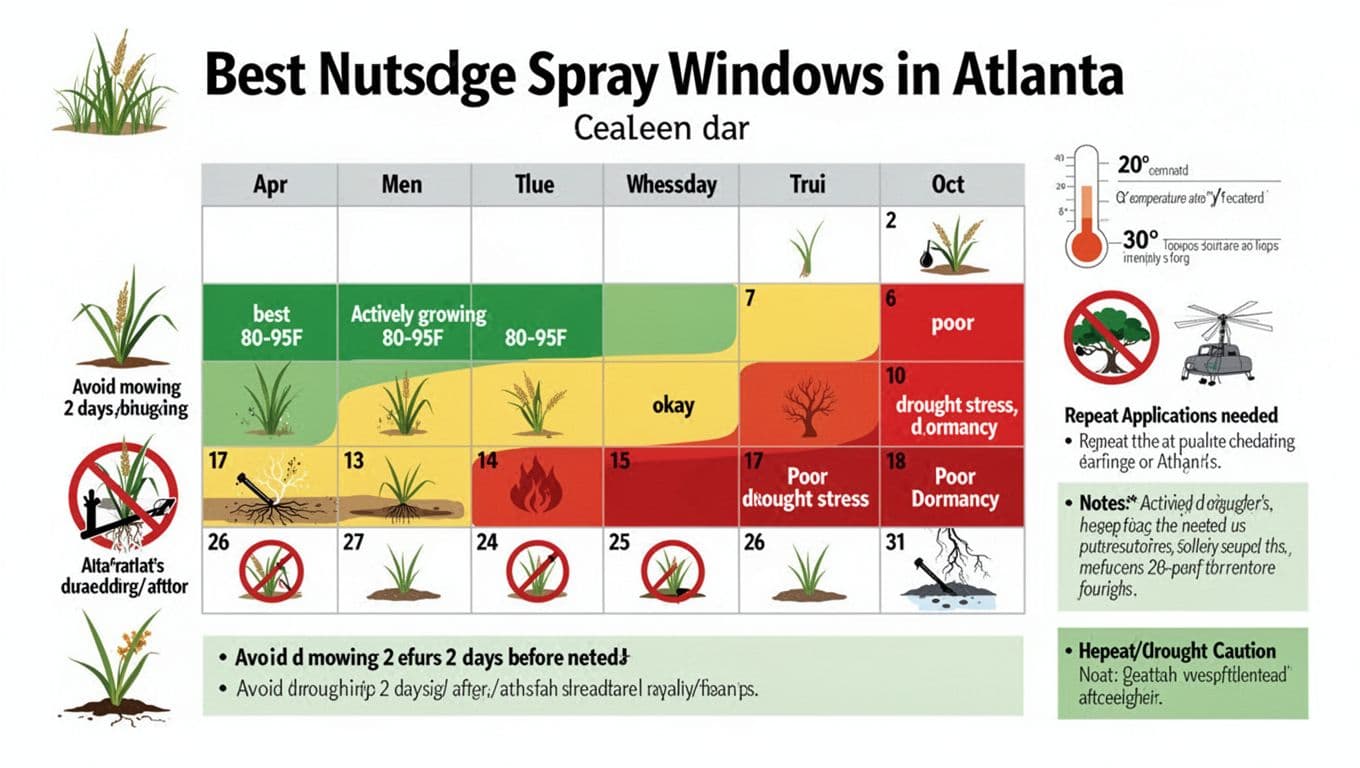 Seasonal spray timing windows for Metro Atlanta, with heat and mowing reminders, created with AI.
In Metro Atlanta, nutsedge usually wakes up after spring green-up and really takes off once nights stay warm. Your best control happens when it’s actively growing , but before it’s spent the whole summer building tubers.
A practical Atlanta calendar:
- Best window (late spring through mid-summer) : Roughly May through July for many lawns, when sedge is growing fast and daytime temps are warm.
- Okay window (late summer) : August into early September can still work, but heat stress and spotty rainfall make timing tricky.
- Poor window (too early or too late) : Early spring before steady growth, and fall as turf and sedge slow down toward dormancy.
A few timing rules that make a real difference:
- Don’t mow 2 days before or after spraying . You want enough leaf surface to catch spray, and you don’t want to remove treated tissue right away.
- Watch irrigation and rain . Avoid spraying if a storm is likely soon. Also don’t irrigate right after, unless the label tells you otherwise.
- Avoid heat and drought stress . If your Bermuda or Zoysia is already bluish-gray and crunchy, hold off. Spraying stressed turf raises injury risk and results can be weak.
- Use steady, even coverage . Nutsedge leaves can shed droplets. A light, even coat on the foliage usually beats “spot blasting.”
For turf-specific options and local guidance, keep the current Georgia recommendations handy through the 2025 Georgia Pest Management Handbook Volume 2 (turf).
What won’t work for nutsedge, plus how to stop re-sprouts for good
A lot of “weed control” methods miss nutsedge because it’s not a broadleaf weed and it doesn’t behave like crabgrass.
Common disappointments (and why)
Pre-emergent crabgrass preventers don’t stop established nutsedge shoots, and nutsedge can still push through thin turf later.
Basic 3-way broadleaf sprays (the common mixes used for clover and dandelion) often don’t touch sedges.
Home remedies like vinegar, salt, dish soap, or boiling water can burn tops and damage turf and soil, but they don’t reliably solve the tuber problem. They also create runoff risks.
Just mowing lower is like trimming a candle wick. It might look better for a day, then it pops right back up.
Active ingredients you’ll see on sedge labels (and turf matters)
Homeowner and pro products commonly use active ingredients such as halosulfuron , sulfentrazone , imazaquin , or bentazon . Each has label limits based on turf type and temperature, and some are a poor fit for certain lawns.
In Atlanta, warm-season turf is most common (Bermuda, Zoysia, centipede, St. Augustine), but tall fescue lawns exist too. Always match the label to your turf, and be extra careful with:
- St. Augustine and centipedegrass , which can be more sensitive to certain herbicides and summer heat.
- Mixed lawns , where one product might be fine for Bermuda but risky for nearby cool-season grass.
If you’re spraying near ornamentals or a vegetable garden, keep drift in mind. Use a coarse spray, avoid windy days, and don’t rinse equipment where it can reach a storm drain.
Why your treatment failed (quick troubleshooting)
If nutsedge laughed at your last attempt, these are the usual reasons:
- Wrong ID : Green kyllinga and other sedges can look similar.
- Bad timing : Too early (not actively growing) or too late (plant is storing energy).
- Mowed too soon : You removed the treated leaves before the herbicide moved down.
- Rain or irrigation too close : Product washed off or got diluted.
- Poor coverage : You hit the turf, not the sedge leaves.
- Re-sprouts from tubers : You needed a follow-up application, not a new product.
For sedge control around landscape beds, NC State Extension also has a helpful overview on controlling sedges in landscape plantings.
Conclusion
Nutsedge isn’t hard because it’s mysterious, it’s hard because it’s persistent underground. Good Atlanta nutsedge control comes down to correct ID, a late spring through summer spray plan, and repeat applications that drain the tubers instead of just scorching the top.
If you stay patient, protect your turf from heat stress, and tighten up mowing and watering, the re-sprouts slow down fast. The goal isn’t a perfect week, it’s a quieter lawn all season.