Drainage Outlet Erosion: Stop Atlanta Pipe Washouts
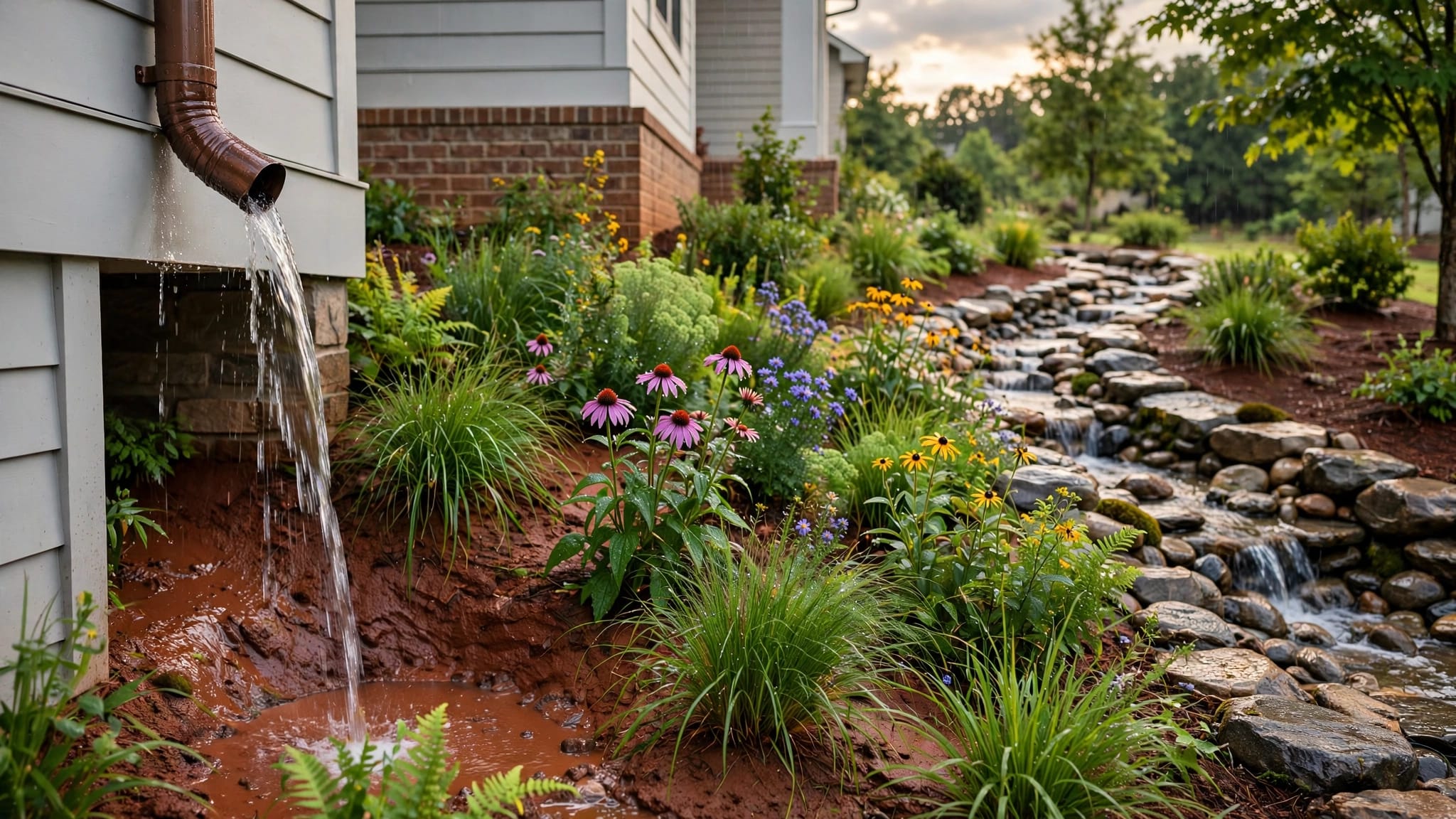
A pipe can move water away from your home and still damage your yard. Drainage outlet erosion starts when concentrated discharge hits bare Georgia clay, a steep slope, or a receiving area that cannot handle the flow.
The lasting fix is not always another load of rock. You need to identify the water source, inspect the pipe and slope, then match the outlet protection to the flow speed and site conditions. This guide explains how to stop repeated washouts without sending water toward a neighbor, foundation, sidewalk, or public drainage system.
Why drainage outlet erosion happens in Atlanta yards
Atlanta-area properties often combine compacted clay, sloped terrain, intense rain, and runoff from roofs or paved surfaces. Clay can absorb water slowly, especially after construction traffic or long dry periods. When water cannot soak in, it travels across the surface with more force.
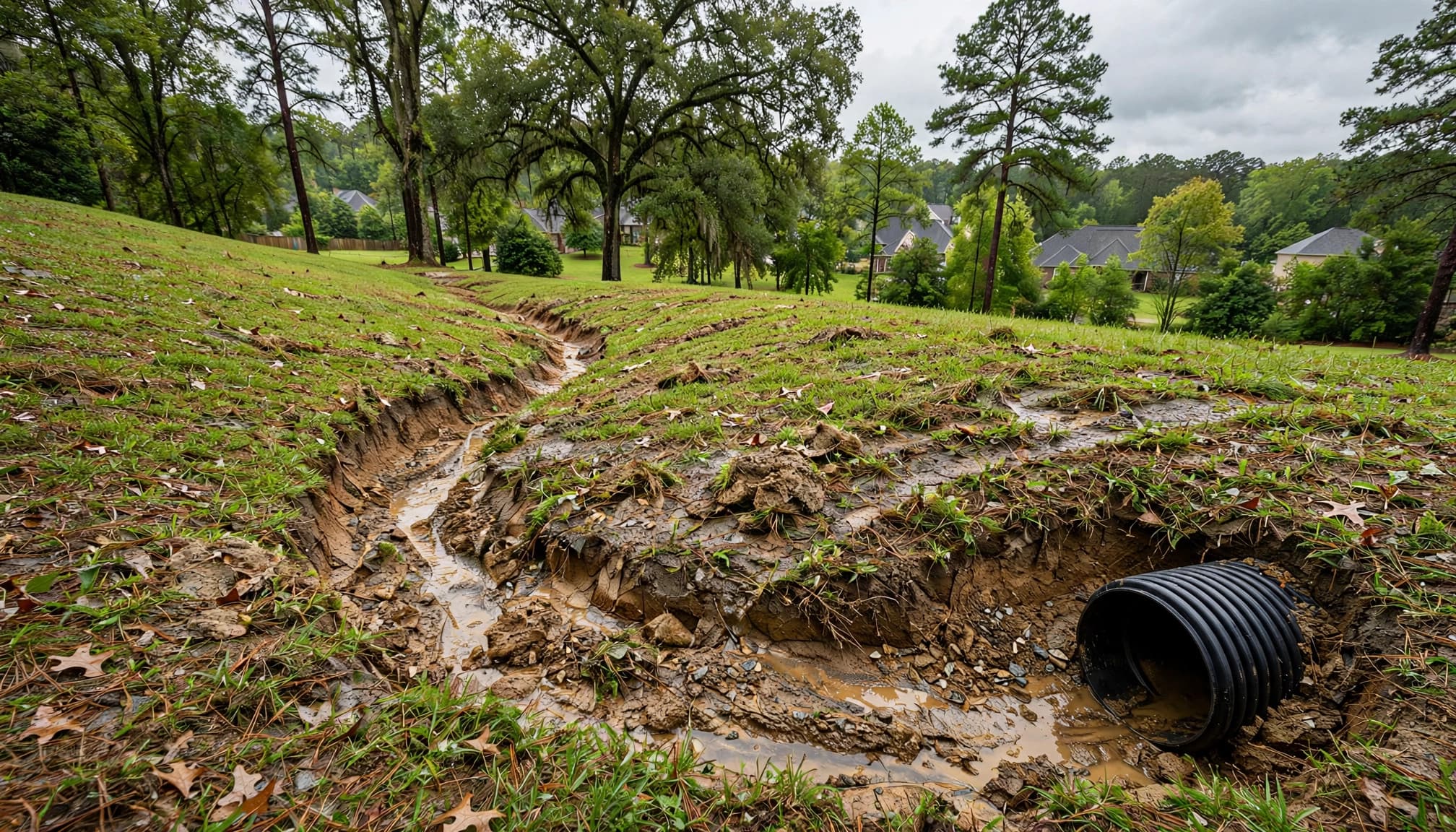
A downspout or buried drain concentrates that water into one narrow stream. If the pipe ends on bare soil, the discharge can cut a channel within a few storms. The channel then becomes deeper, which increases the speed and volume of future runoff.
Watch for these signs:
- Soil has washed away directly below the pipe.
- The pipe end is exposed, tilted, or suspended above a hollow.
- Grass has disappeared along a narrow channel.
- Stones have moved downhill after storms.
- The outlet is undermining a slope, wall, fence, or walkway.
- Mud or sediment is reaching a sidewalk, driveway, street, or storm inlet.
A useful Atlanta erosion control guide for sloped yards can help you distinguish sheet flow, small rills, deep gullies, and bank sloughing. The important point is simple: stabilizing the outlet will not last if the water source or overall grade continues sending excessive runoff to the same location.
How to inspect drainage outlet erosion before repairing it
Inspect the site after a storm, but wait until the ground is safe to walk on. Do not stand below an unstable bank or enter moving water. Take photos from several angles and mark where the water starts, where it travels, and where soil collects.
Check the pipe, slope, and discharge path
Start at the inlet. Clear leaves from gutters, catch basins, and visible pipe openings. Check whether a downspout connection is leaking or whether several roof drains feed a line that may be too small for the added volume.
Next, follow the pipe to its outlet. Look for crushed sections, separated joints, sagging corrugated pipe, or a pipe that has settled lower than the surrounding grade. A leaking joint can saturate soil beneath the outlet and make erosion worse.
Measure or estimate the slope below the pipe. A fast discharge aimed down a steep bank needs more protection than a short outlet on nearly level turf. Also trace the receiving route. Water should move toward a stable area, not stop in a low bowl or cross a property boundary.
Look for undermining and downstream damage
Check the pipe's underside and both sides of the outlet. Erosion that travels beneath the pipe can leave it unsupported. Erosion that cuts around the sides can flank the repair and continue into the surrounding bank.
Follow the flow beyond the visible washout. A stone apron may stop damage at the pipe while moving the problem farther downhill. Look for new ruts, muddy water, exposed roots, wet spots near a foundation, or sediment reaching a public ditch.
If the outlet has no stable receiving channel, the project needs more than surface covering. The solution may involve a swale, regrading, a longer stabilized channel, or an energy-dissipation feature.
Choose a repair that matches the washout
The correct method depends on flow speed, discharge volume, slope, soil condition, and the stability of the area receiving the water. Loose rocks dumped over a hole may hide the damage briefly, but they often sink into clay or wash away when the outlet remains undersized or unsupported.
Use a riprap apron for moderate flow
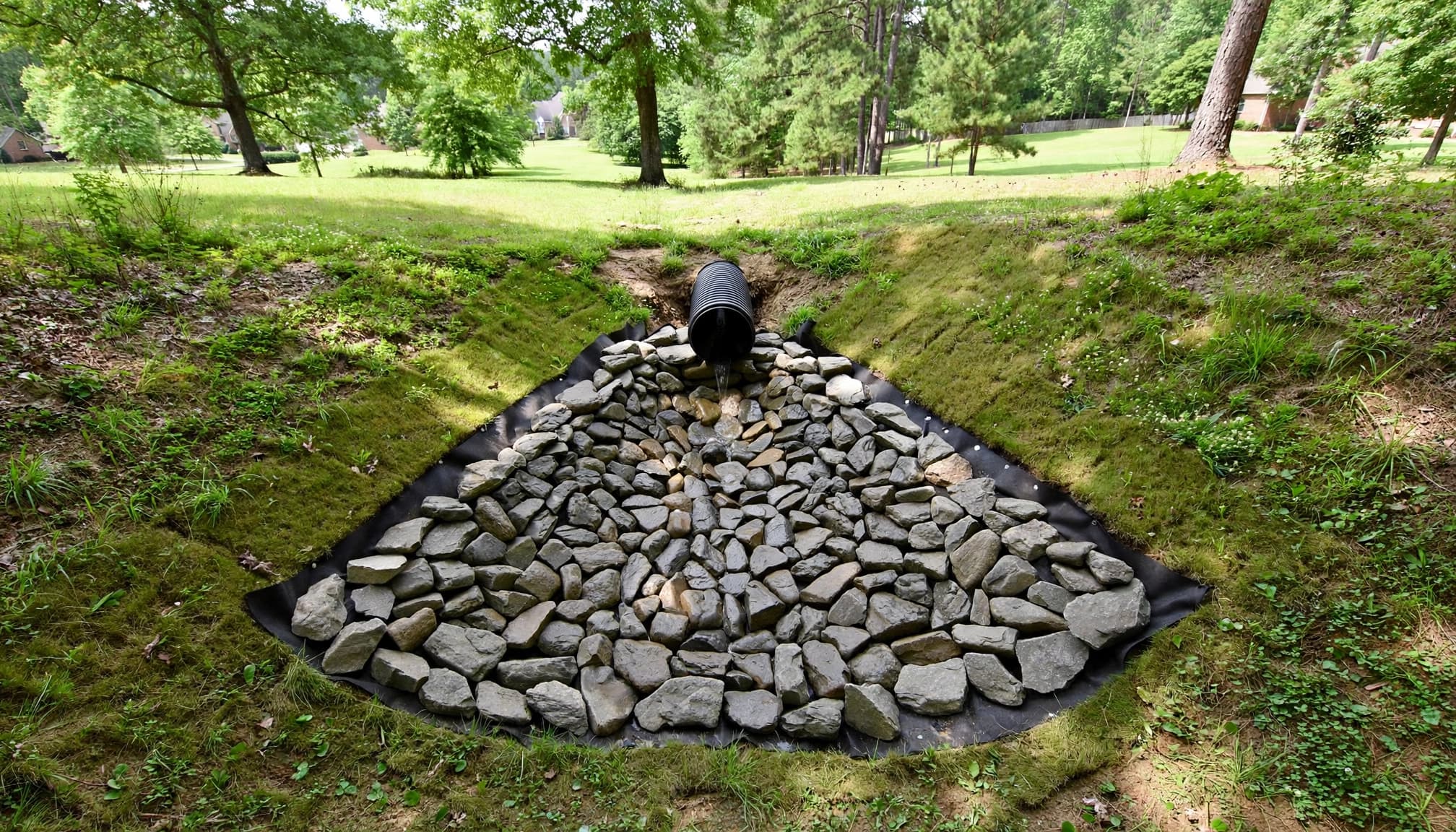
A riprap apron spreads discharge across a wider, protected area. It commonly includes properly sized stone over a geotextile filter or a prepared granular layer. The filter separates clay from the stone while allowing water to pass through.
The stone needs a firm base and secure edges. It should extend far enough beyond the pipe to prevent the jet from cutting around the end. The upstream edges and side edges need attention because water can bypass an apron if the transitions are abrupt.
A finished apron can work well for a residential outlet with moderate velocity and a stable receiving slope. It is less suitable when water drops over a steep bank, forms a deep plunge pool, or moves large debris during storms.
Add an energy dissipator for fast or falling water
Fast water needs to lose energy before it reaches bare soil. Depending on the site, a contractor may use a plunge basin, a larger stone treatment, a level spreader, a stepped channel, or another designed energy dissipator.
These systems require more planning than a small splash pad. The outlet elevation, tailwater, basin size, soil strength, and downstream escape route all affect performance. A high-velocity pipe discharge can move large stones if the protection is too light.
FHWA guidance treats riprap outlet protection as appropriate for moderate velocities. Very high velocities may need a formal dissipator rather than a standard apron.
Regrade the route when the whole slope is failing
Sometimes the pipe is only exposing an existing grading problem. If water runs toward the home, pools above the outlet, or spreads across a bare bank, regrading may provide a better long-term fix than enlarging the rock pad.
A shallow swale can guide surface water around a structure and toward a stabilized discharge area. New bare soil should receive mulch, erosion-control matting, straw, vegetation, or another temporary cover before the next major storm.
For larger corrections, review Atlanta grading and paving services and ask for a scope that explains where the water will travel during heavy rain.
Size the outlet protection for real flow
Outlet dimensions should reflect the pipe diameter, design discharge, velocity, slope, and receiving ground. A repair that works for one downspout may fail when several roof areas feed the same line.
Several transportation-agency manuals provide useful design examples, but their dimensions are not universal Atlanta requirements. One BMP manual describes an apron length of about six times the pipe diameter, called 6D, and a width of about four times the diameter, called 4D. It also references a geotextile layer beneath the riprap.
Another design manual uses a minimum upstream width of three times the pipe diameter, or 3D, and extends protection about one foot above the pipe invert. These are examples for designers to evaluate, not measurements to apply blindly to every residential yard.
Stone size also matters. A well-graded mix with larger stones can resist movement better than small decorative gravel. One manual limits the largest stone diameter to no more than 1.5 times the median stone size, which helps create a more stable gradation.
The protection should end without a sharp drop or exposed edge. FHWA drawings show riprap apron applications on culvert outlets with slopes up to 10 percent, but the receiving channel and flow conditions still need review. A local site may require a different approach.
Build the repair on a stable base
A durable outlet repair starts with excavation and preparation, not stone placement. Remove loose soil, organic debris, and unstable material until the base can support the protection. Shape the area so water spreads through the intended path.
Place a suitable geotextile filter or granular filter between the clay and armor material. This layer helps prevent soil from piping through the stone, reduces sinking, and lets seepage escape. Without separation, Georgia clay can migrate into the voids and leave the rock unsupported.
Set the pipe securely and protect its sides. The outlet should not hang over an empty cavity or point directly into a steep cut. Use properly sized stone, compacted aggregate, or another approved detail to transition from the pipe to the apron.
Secure the edges and downstream end. Water often finds the weakest side of a repair, then works behind the stone. Finish the surrounding soil with grass, mulch, matting, or suitable plants so the next storm does not expose the edges.
Before digging, call 811 for utility locating. If the work includes broader soil disturbance, drainage changes, or site preparation, Metro Atlanta land clearing services may be relevant to the grading and stabilization scope.
When to call a drainage professional
A qualified drainage or erosion-control professional should review the site when the pipe repeatedly washes out, the discharge travels down a steep slope, or the outlet affects a retaining wall, foundation, culvert, or public drainage feature.
Get site-specific help when:
- The pipe is crushed, separated, buried, or structurally damaged.
- A bank is collapsing or the ground is moving beneath the outlet.
- Water flows from several downspouts or a large uphill drainage area.
- The repair needs a basin, retaining structure, major regrading, or a new channel.
- The proposed discharge could affect a neighbor, creek, sidewalk, roadway, or storm drain.
- You cannot identify a safe final destination for the water.
A retaining wall may need its own drainage and structural review. Atlanta retaining wall installation can be part of a larger solution when elevation changes cannot be stabilized with grading and vegetation alone.
Work affecting a public ditch, culvert, right-of-way, or stormwater system may also require local approval. Ask the contractor who handles design, utility locating, permits, excavation, erosion control, and final restoration.
Key takeaways for stopping pipe washouts
- Find the water source before treating the damaged soil.
- Inspect the pipe, outlet, side edges, downstream channel, and final receiving area.
- Match stone size and protection length to flow, slope, and pipe capacity.
- Use geotextile or granular separation beneath rock on clay soils.
- Secure the pipe and terminate the repair so water cannot undermine or flank it.
- Cover bare soil quickly after grading with mulch, matting, turf, or suitable plants.
- Never redirect runoff onto a neighbor's property or toward a foundation.
- Choose professional review for severe erosion, structural damage, culvert work, or public drainage connections.
FAQ about Atlanta drainage outlet erosion
Can I fix a small washout with river rock?
River rock may work for a low-flow discharge on a stable, nearly level area, but it is not a universal repair. Small or rounded stones can move during heavy rain. A proper base, filter layer, outlet transition, and secured edges matter as much as the visible stone.
Should the outlet empty onto grass?
Grass can protect a low-energy discharge if the soil is stable and the flow spreads instead of cutting a channel. Bare clay, a steep slope, or a concentrated jet usually needs an apron, stabilized swale, or another erosion-control detail.
How do I know whether the pipe is too small?
Repeated ponding, backup at the inlet, flow escaping around joints, or a washout that returns after repair can indicate a capacity or slope problem. Multiple downspouts connected to one line also increase demand. A professional can evaluate the drainage area and design discharge.
Can I extend the pipe to another part of the yard?
Only if the new route has a stable destination and does not create downstream damage. An extension that ends at a property line, steep bank, foundation, sidewalk, or public drain can transfer the problem instead of solving it.
Conclusion
A lasting repair for a washed-out pipe outlet begins with water control, not decorative rock. Inspect the source, confirm the discharge path, prepare a stable base, use a filter layer, and size the protection for actual flow conditions.
Small outlets may need a carefully built apron and restored turf. Steep slopes, repeated failures, high velocities, culverts, and structural damage call for professional review. When the final discharge stays controlled and the surrounding soil remains covered, your lawn has a better chance of holding through Atlanta's next heavy storm.