Atlanta Drainage Fix Guide for Soggy Lawns, French Drains vs Regrading vs Dry Creek Beds (how to pick the right fix)
If your grass squishes when you walk across it, your yard isn't "getting watered." It's staying wet , and that's when turf thins, weeds move in, and mud tracks into the house.
The good news is most Atlanta soggy lawn problems come from a few repeat causes. Better news, you don't have to guess between a French drain, regrading, or a dry creek bed. With a couple simple checks, you can pick the fix that matches your yard instead of paying twice.
Why Atlanta lawns stay soggy after rain
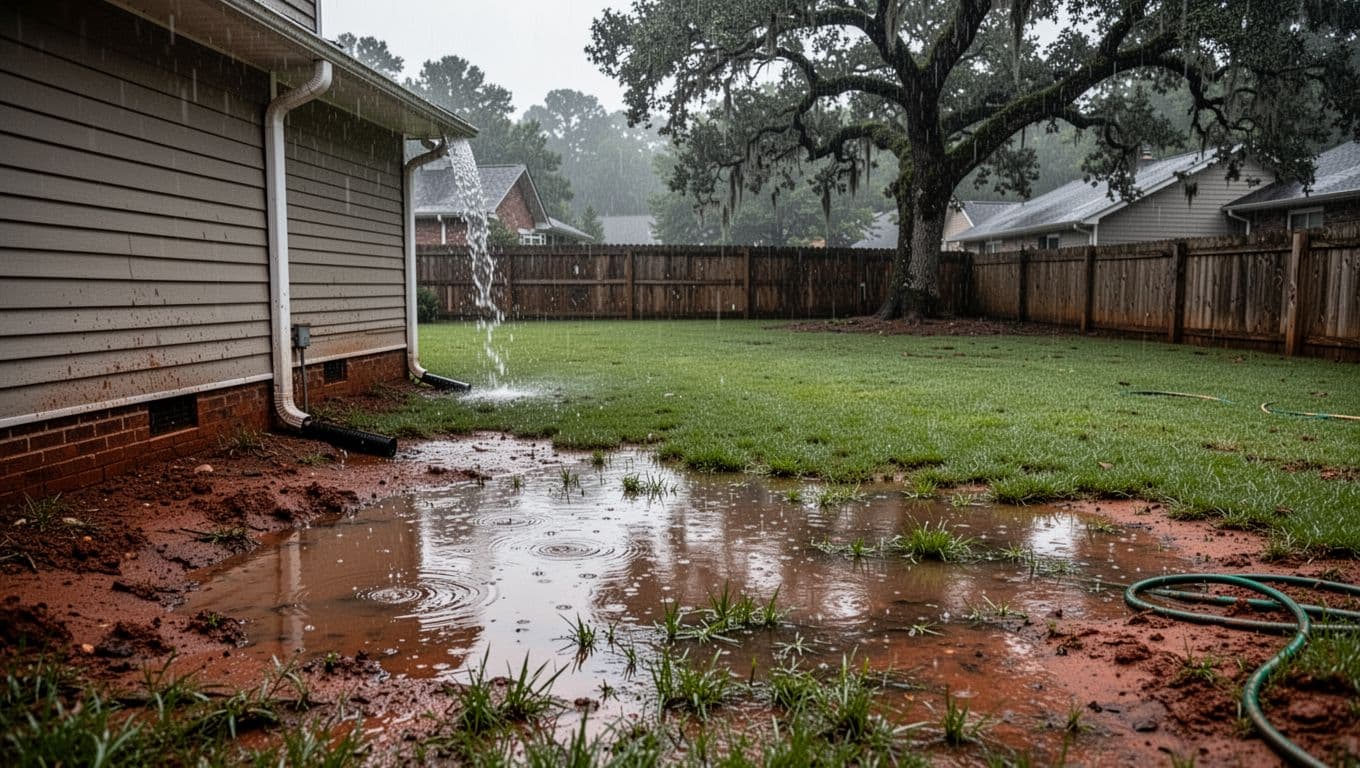 Standing water in low spots is common in Metro Atlanta, especially with clay soils and short downspouts, created with AI.
In Metro Atlanta, heavy clay is the usual suspect. Clay holds water, seals over when it compacts, and drains slowly. That means a "small" low spot can stay wet for days, even when the rest of the yard dries out. UGA Extension has a helpful local overview of practical fixes in improving drainage in residential gardens and lawns.
Next, roof runoff causes more soggy lawns than most homeowners expect. One downspout dumping near the foundation can act like a constant hose during storms. Add a negative slope toward the house, and water has nowhere safe to go.
Finally, some problems are "surface water" (you can see flow), while others are "subsurface water" (the soil stays saturated). If your lawn also gets fungus in summer, poor drainage often plays a role because wet turf stays humid longer. If that sounds familiar, this Atlanta lawn disease ID guide helps you tell drainage-driven stress from true disease.
Here's the key idea for atlanta yard drainage: your best fix depends on whether you need to move water, reshape the yard, or slow and spread runoff .
A 30-minute backyard check to choose the right drainage fix
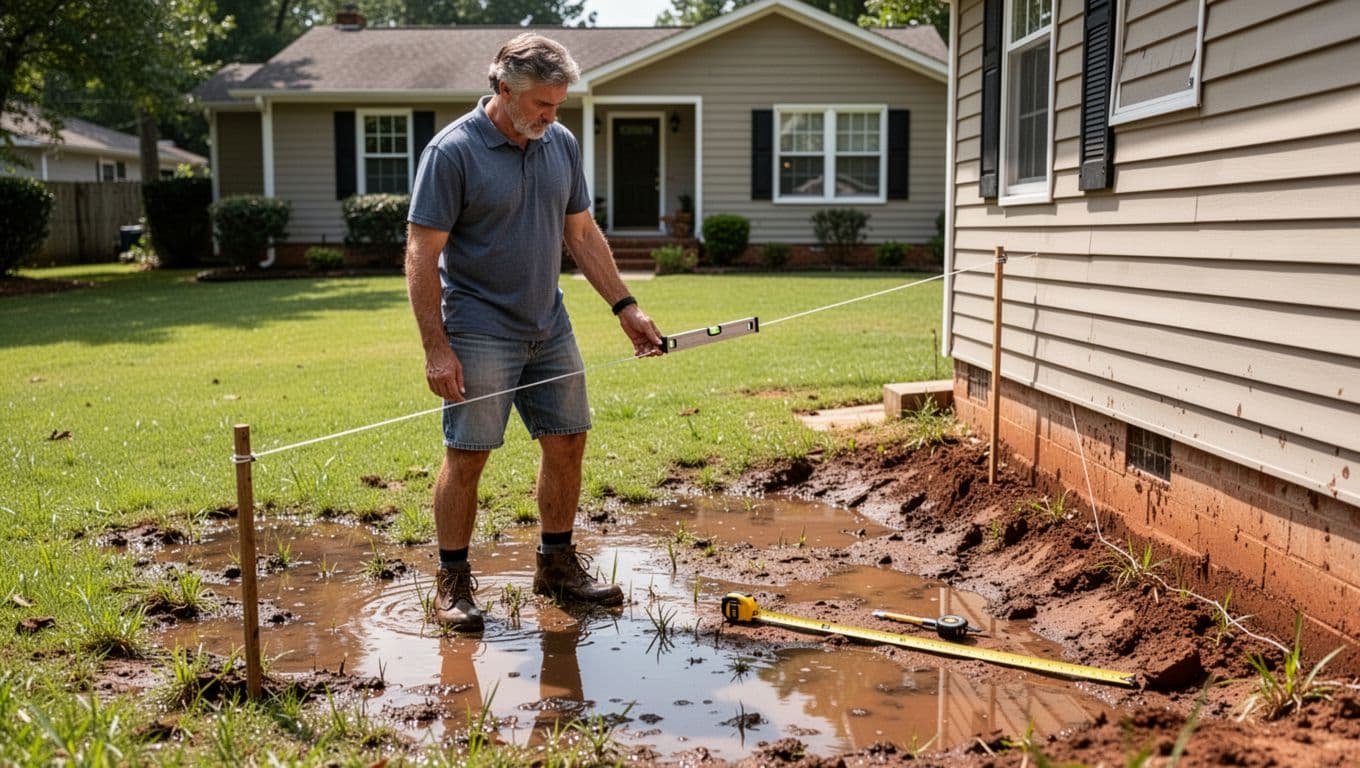 Measuring slope with a string line and level is a fast way to spot drainage issues, created with AI.
Start with observation after a real rain. Walk the yard and note where water starts, where it travels, and where it ponds. Then do these two quick measurements.
1) Measure slope with a string level (no fancy tools)
You need two stakes, mason string, a line level, and a tape measure.
- Push one stake near the house (not against the foundation).
- Push the other stake 10 feet away toward the soggy area.
- Tie string between stakes and level it.
- Measure the vertical drop from the string down to the ground at the far stake.
How to read it:
- A healthy "positive grade" away from the home is about 5% for the first 10 feet (roughly a 6-inch drop over 10 feet).
- If the yard is flat or slopes back toward the house, regrading often beats adding pipe.
If water sits within 10 feet of the foundation, treat it as a grading and runoff problem first, not a "drainage pipe" problem.
2) Do a simple infiltration test (how fast does your soil drink water?)
Dig a hole about 12 inches deep and 6 inches wide in the problem area. Fill it with water once to pre-soak the clay. Refill it, then track how many inches drop in an hour.
A basic rule of thumb:
- Fast (over 1 inch per hour): the yard can absorb, you mostly need to guide flow.
- Slow (under 0.5 inch per hour): the soil holds water, so you'll likely need a drain, regrade, or a rock channel with an outlet.
Also check for compaction. If a screwdriver won't push in easily, your soil may be sealed. In that case, aeration plus compost topdressing can help, but it won't fix a true low spot by itself.
French drains vs regrading vs dry creek beds, how each one solves a different problem
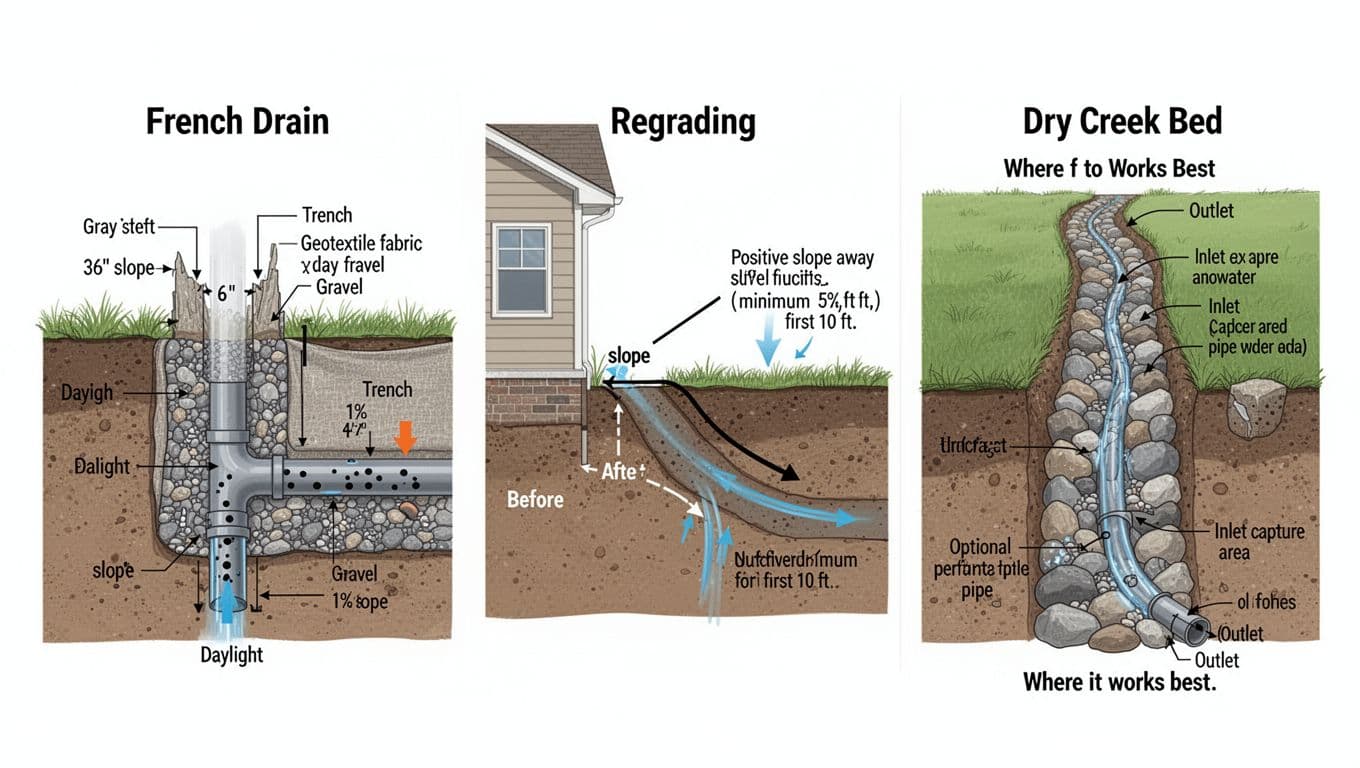 Side-by-side diagram of three common drainage fixes used in Atlanta yards, created with AI.
Before comparing, one truth saves a lot of wasted work: every system needs a legal, lower outlet . If you don't have a place to discharge, you're not "draining," you're storing water.
Here's a clear comparison to help you choose.
| Fix | Best when you see… | What it does | Watch-outs |
|---|---|---|---|
| French drain | Soggy strip or low area that stays wet, water seems to "sit in the soil" | Collects water below grade and moves it to an outlet | Needs slope (often ~1% is a good target), proper fabric, and a real discharge point |
| Regrading (plus swales) | Water runs toward the house, pooling near foundation, obvious low spots | Reshapes the yard so gravity does the work | Can affect landscaping, often needs topsoil and turf repair, must avoid dumping water onto neighbors |
| Dry creek bed (dry swale) | You can see surface flow during storms, erosion channels, downspout washouts | Creates a visible path to carry and slow runoff | Must be sized to handle storms, needs underlayment, rocks can sink into clay without prep |
Takeaway: choose regrading when slope is wrong, choose a French drain when the soil stays saturated, choose a dry creek bed when runoff needs a controlled surface path (and you want it to look intentional).
A few "rules of thumb" that prevent most failures
- Regrading near the home: aim for that 5% positive slope away from the foundation for the first 10 feet when possible.
- Swales: a gentle channel can work well at about 1% to 3% slope along its run, as long as it keeps moving.
- French drains: keep the trench sloped to discharge, avoid flat runs. Many installs target about 1% slope (about 1.25 inches of fall per 10 feet).
- Downspout tie-ins: use solid pipe , not perforated pipe, until you reach the intended drainage area or outlet.
Cost varies a lot in Atlanta. Length, digging depth, access for equipment, rock volume, and outlet options drive the range. A short downspout reroute might be a small job, while a full yard regrade with new sod can be a bigger project.
Placement rules and "don't do this" mistakes (Atlanta edition)
Good atlanta yard drainage protects your home and keeps you out of neighbor disputes.
Smart placement rules
Keep yard drains away from the home's footings unless an engineer or waterproofing plan calls for it. In many yards, a safer approach is to correct grade and control downspouts first, then drain low areas farther out. Also call 811 before digging.
If you have septic, stay cautious around the drainfield. UGA Extension covers what belongs near that area in ornamental plantings on septic drainfields. Don't trench or route concentrated water into a drainfield zone.
For broader context on runoff and why managing stormwater matters in Georgia, UGA's updated bulletin on urban storm water management in Georgia is worth bookmarking.
The biggest pitfalls to avoid
- Dumping water at the property line: that's how drainage "fixes" turn into complaints.
- Undersized pipe: 4-inch is common for many yard drains, but long runs or multiple downspouts may need larger. Size depends on area and slope.
- Skipping fabric in clay: without geotextile, gravel fills with fines and stops draining.
- Flat trenches and low outlets: water won't move, it'll just sit in the pipe.
- Perforated pipe on downspouts: it leaks water where you don't want it, often right beside the house.
For a practical, non-sales overview of urban drainage troubleshooting, Oklahoma State Extension's guide on addressing drainage issues in the urban landscape lines up well with what works in Atlanta too.
If soggy areas also look scalped or thin, mowing height can make it worse. This Atlanta mowing height guide explains how cutting too low stresses turf in wet, compacted soil.
Conclusion
A soggy lawn feels like a mystery, but it usually isn't. Measure slope, test how fast the soil drains, then match the fix to the cause. Regrading corrects bad pitch, French drains move subsurface water, and dry creek beds control visible runoff. When you design for a real outlet and avoid the common mistakes, atlanta yard drainage stops being a constant battle and becomes a one-time upgrade that protects your turf and your home.