Atlanta Grub Control for Bermuda and Zoysia, how to confirm grubs, choose preventive vs curative, and time treatments
A lawn can look fine on Monday, then feel like it’s coming loose by Saturday. If you’ve got Bermuda or Zoysia in Metro Atlanta and you’re seeing soft, thinning patches, atlanta grub control usually comes down to one thing first: proving grubs are actually there.
Grubs are sneaky because the damage looks like other problems. The fix also depends on timing. A great preventive applied at the wrong time can do almost nothing, and a curative used too late can feel like throwing money at a bald spot.
Below is a practical, homeowner-friendly way to confirm grubs, avoid common misdiagnoses, and choose preventive vs curative treatments based on Atlanta timing.
Confirming grubs in Bermuda and Zoysia (the right way)
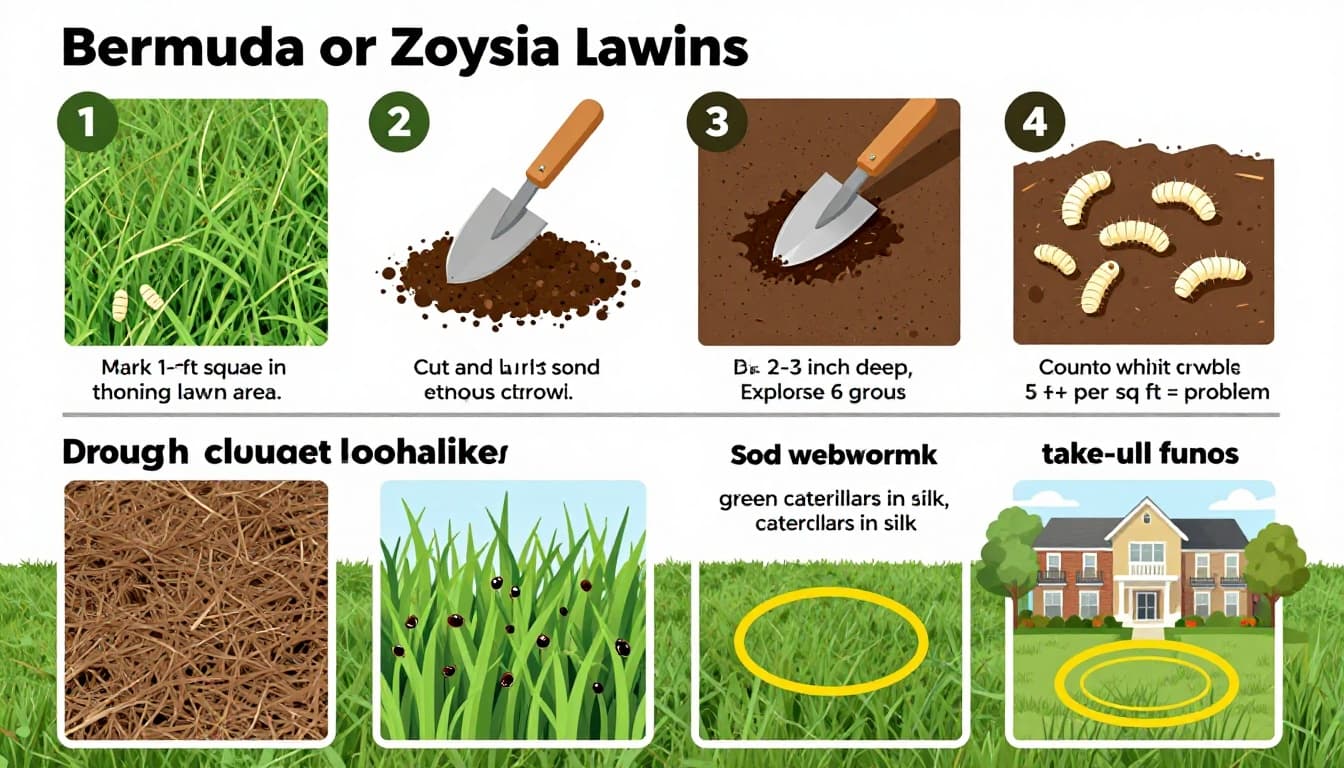 Step-by-step visual for checking turf roots for grubs and separating grub damage from common lookalikes, created with AI.
Grubs are the C-shaped larvae of certain beetles. They feed in the root zone, so the grass can’t take up water, even if you’re irrigating. In Atlanta, the first clue is often a patch that browns faster than the rest, then starts to lift like old carpet.
Step-by-step: how to check for grubs
Do this before you buy anything.
- Pick the right spot: Don’t dig in the dead center of a totally brown area. Dig at the edge where green meets thinning turf. That’s where active feeding is most likely.
- Sample size: Cut a 1-foot by 1-foot square (a flat shovel or hand spade works). Try 2 to 3 samples in different spots if the damage is spread out.
- How deep to dig: Slice the sod on three sides, peel it back, then break up the soil 2 to 3 inches deep . That’s the main root zone for Bermuda and Zoysia.
- Best time of day: Check early morning or late afternoon , and ideally a day after rain or irrigation . Moist soil makes it easier to lift sod and spot larvae.
- How to count per square foot: Since your plug is 1 square foot, count what you find in that plug. If you’re using a smaller tool, measure your cut area so you’re not guessing.
- What number matters: If you repeatedly find about 5 or more grubs per square foot in areas that are thinning, grubs may be driving the problem. Fewer grubs can still matter in stressed lawns, but it often points to another cause.
A quick ID check: grubs are usually creamy white, C-shaped, with a brown head and three pairs of legs near the front. If you’re seeing worms with no legs, or thin larvae that aren’t C-shaped, you may be dealing with something else.
The lookalikes that fool Atlanta homeowners
Before you treat, scan for these common “false grub” situations:
- Drought stress: Turf turns bluish-gray, footprints linger, and areas near pavement crisp first. Soil feels dry several inches down.
- Fungus (like large patch in Zoysia): Patches can have a subtle ring, orange or yellow edges, and the grass blades pull apart differently than grub damage.
- Chinch bugs: More common in hot, sunny areas. Grass looks wilted even with water. Bugs are tiny and fast, often near sidewalks or driveways.
- Sod webworms: You’ll see birds pecking, or ragged chewing on blades. A soap-and-water flush at dusk can bring caterpillars up.
If you’re unsure after digging, your county office can help you confirm the pest and timing; UGA’s turf team also publishes reference material through the UGA turfgrass pest control recommendations.
Preventive vs curative atlanta grub control, and when each works
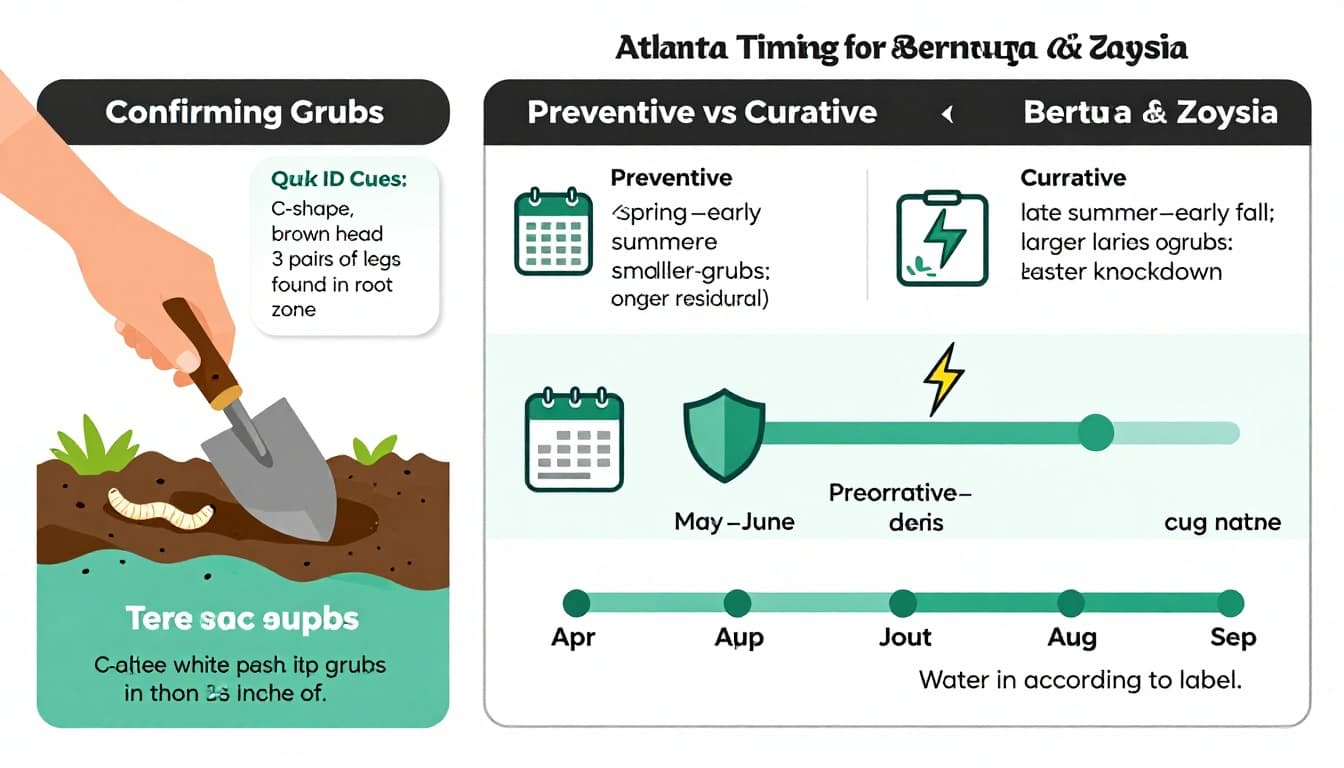 Seasonal timing and treatment type at a glance for Bermuda and Zoysia lawns in Atlanta, created with AI.
Think of preventive products like setting a smoke detector, and curatives like using a fire extinguisher. Both can help, but only when used at the right moment.
Preventive treatments (best for late spring to early summer)
Preventives target young grubs before they grow large and chew through roots. For homeowners, a common preventive active ingredient category is chlorantraniliprole (where labeled for turf and grubs). It’s typically applied before you see damage , then watered in so it sits where larvae feed.
Preventive is usually the better choice when:
- You’ve had grub problems in the same areas in past years.
- Your lawn is mostly healthy, and you want to avoid late-summer surprises.
- You’re timing it for when egg hatch and small larvae are expected.
Curative treatments (best when grubs are confirmed and actively feeding)
Curatives are meant for situations where you’ve dug and confirmed grubs, and the lawn is actively declining. Common curative active ingredient categories include trichlorfon or carbaryl-type products, but only use products that are labeled for your turf type and for Georgia, and follow watering directions exactly.
Curative is usually the better choice when:
- You find grubs in the root zone and turf lifts easily.
- Damage is growing week to week.
- It’s late summer and preventives are no longer well-timed.
For Georgia-specific labels, rates, and restrictions, use UGA’s references like the Georgia Pest Management Handbook turfgrass chapter (PDF). Product labels change, and that’s the document your plan should match.
Atlanta-centric timing guide (weather shifts the exact dates)
Here’s a practical month-by-month way to plan without guessing:
| Month (Atlanta) | What’s happening | Best move |
|---|---|---|
| April | Turf waking up, beetle activity not at peak | Watch for past hotspots, don’t rush |
| May to June | Prime preventive window in many years | Apply preventive if you’ve had issues |
| July | Heat stress rises, early damage can start | Confirm with digging before treating |
| August to September | Larger grubs can cause fast damage | Curative only if grubs are confirmed |
| October | Cooling slows feeding | Focus on recovery, avoid late, low-odds sprays |
Timing varies by weather and lawn microclimates (sunny front yard vs shaded backyard). When in doubt, the shovel test beats the calendar.
Watering-in, mowing, and safety after a grub treatment
Most grub products fail for one simple reason: they never reach the root zone. After application, plan to irrigate enough to move the product down, but not so much it runs off on Atlanta clay.
A common target is about 0.25 to 0.5 inch of irrigation right after application (or as the label states). A tuna can in the yard is an easy way to measure. If the label calls for more or less, follow the label.
A few practical guardrails help Bermuda and Zoysia recover while you’re treating:
- Mow timing: Mow 1 to 2 days before treatment, then avoid mowing until the lawn is dry and the product has been watered in. Keeping the right mowing height also reduces stress; this Atlanta mowing height guide for Bermuda and Zoysia helps you avoid scalping when the lawn is already struggling.
- Traffic: Limit play and heavy foot traffic on soft, thinning areas. Damaged roots plus compaction is a rough combo.
- Kids and pets: Keep everyone off the lawn until the application is complete and the area is dry (and watered in if the label requires it) . Store leftover product locked up.
- Pollinator-friendly precautions: Don’t apply over blooming weeds . Mow off flowers first, then treat, so pollinators aren’t foraging in the area during application.
When to call a pro or get help confirming the cause
Call for help when the damage spreads fast, you find zero grubs after multiple samples, or the lawn has a pattern that suggests disease or irrigation issues. You can also bring photos and a description to your local UGA Extension office, or use the UGA turfgrass bulletin page to find updated Georgia guidance that matches your situation.
Conclusion
Good atlanta grub control starts with proof. Cut a 1-foot square at the edge of damage, count what’s in the top 2 to 3 inches, then match the product type to the season. Preventives are for late spring planning, curatives are for confirmed late-summer feeding, and watering-in is what makes either one work. If the shovel says “no grubs,” listen to it, and fix what’s really stressing your Bermuda or Zoysia.