
Atlanta Trench Drain Installation Cost Guide for 2026
Standing water at the bottom of a driveway or beside a loading area can turn a hard rain into a property problem. In Metro Atlanta, a properly placed channel drain catches that runoff before it reaches a garage, doorway, foundation, or worn-out patch of pavement.
For 2026, trench drain installation cost in Atlanta often falls between $30 and $150 per linear foot for standard residential work. The final number depends less on the drain alone and more on what the crew must cut, excavate, connect, and restore.
A good quote starts with the water path, the finished surface, and a realistic look below ground.
Atlanta trench drain installation cost in 2026
A trench drain is a long surface channel covered by a grate. It collects water across a driveway, patio, parking area, pool deck, or garage threshold, then moves it through pipe to a safe outlet.
For a straightforward Atlanta residential project, expect about $1,200 to $4,500 for 30 to 50 linear feet. This assumes a light-duty channel, accessible work area, moderate excavation, and an outlet that does not require a long pipe run or major pavement repairs.
Longer, deeper, or concrete-heavy work costs more. HighGrove Partners lists Atlanta trench drains at roughly $30 to $150 per linear foot, depending on the channel and grate material. Heavy-duty commercial systems can run about $180 to $500 per linear foot when traffic loads, demolition, and deeper site work increase the scope.
| Project type | Typical Atlanta range | Common assumptions |
|---|---|---|
| Small patio or walkout drain, 20 to 30 feet | $900 to $2,500 | Light-duty channel, open access, short outlet run |
| Residential driveway drain, 30 to 50 feet | $1,200 to $4,500 | Concrete cutting, channel, pipe connection, patching |
| Long driveway or garage approach, 60 to 100 feet | $3,000 to $9,000 | More excavation, larger concrete repair area, longer piping |
| Commercial entrance or loading zone | $180 to $500 per foot | Heavy-duty channel and grate, traffic-rated concrete work |
These ranges are planning figures, not guaranteed quotes. The same 40-foot drain can cost far more when it crosses thick reinforced concrete or needs a new catch basin.
What a trench drain project includes
The visible grate is only the top layer. A drain works because the channel sits at the correct elevation, rests on a stable base, and has a route for the collected water.
Cutting, excavation, and channel setting
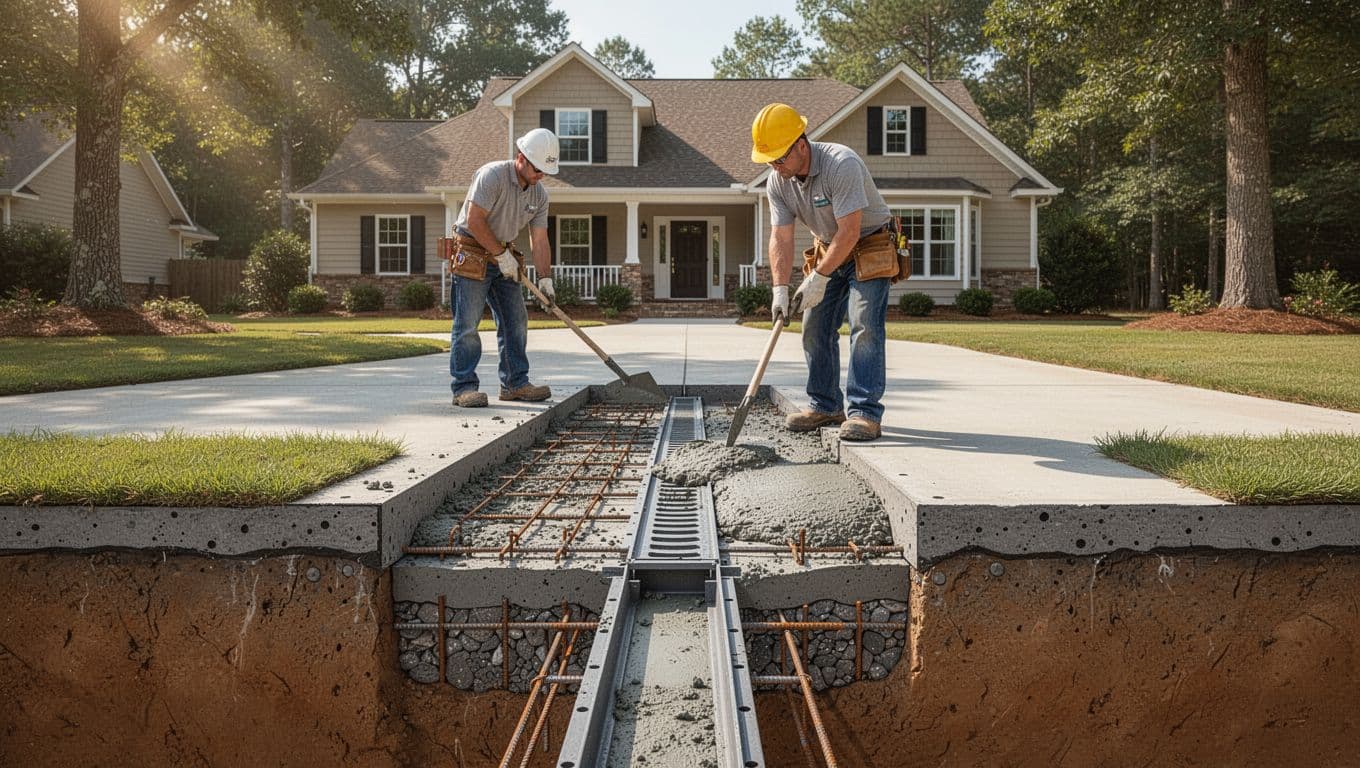
For a driveway installation, a crew usually saw-cuts the existing concrete or asphalt, removes material, digs to the required depth, and prepares the trench base. The channel must sit low enough to accept runoff without creating a tire-catching edge or low spot.
Homewyse lists 2026 national trench-digging costs at roughly $11.55 to $27.48 per linear foot. Backfill adds about $3.47 to $13.14 per foot. Those figures are useful labor benchmarks, but they do not include the channel, grate, pavement removal, concrete replacement, or drainage connection.
Concrete, asphalt, and restoration
The crew then anchors the drain and places concrete around it. On asphalt, the work may include cutting a wider section, rebuilding the base, and tying new asphalt into the existing surface.
Restoration can make up a large share of the bill. A channel across an intact concrete driveway often requires more labor than one installed in bare soil before paving begins. If the project includes a new drive, patio, or walk, coordinating the drain during driveway and patio site preparation usually avoids later demolition.
A trench drain only solves a water problem when its outlet can carry water away without sending it back toward the building or a neighboring property.
Drain materials and load ratings change the price
A residential patio drain and a commercial loading-area drain may look similar on the surface. Below the grate, their channel strength, concrete surround, and load requirements can be completely different.
Light-duty channels for homes
Plastic channels are often the least expensive choice for sidewalks, patios, pool decks, and low-traffic areas. Many use removable plastic or galvanized grates. They can work well when the base is stable and the grate rating matches the actual use.
Polymer concrete channels cost more but resist wear and handle heavier applications. Fiberglass systems can also fit certain installations. Material costs rise further with decorative metal grates, stainless steel, or cast-iron components.
Traffic-rated systems for businesses
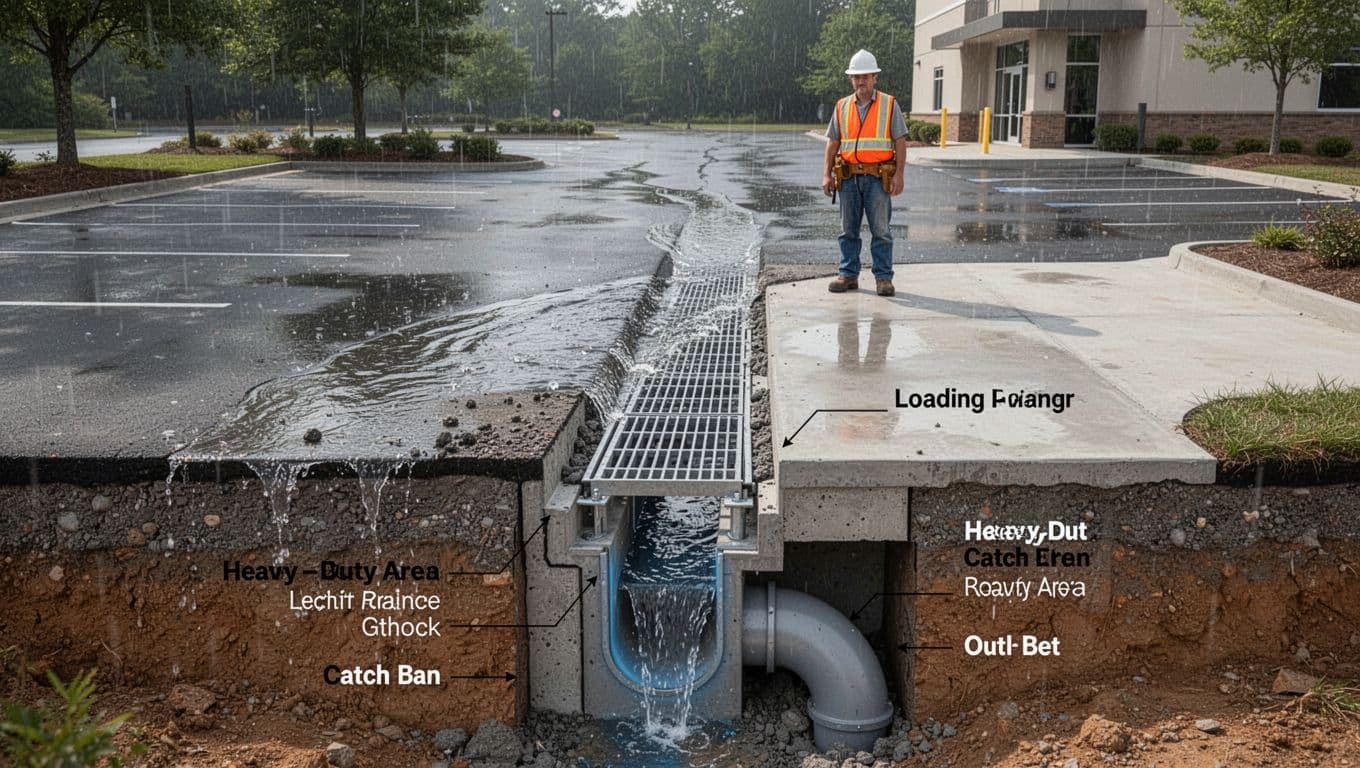
Parking lots, dumpster pads, service entrances, and loading areas need a system designed for vehicle weight. A light residential grate can crack or shift under repeated traffic, even if it looks fine after installation.
Ask the contractor to identify the planned load rating , rather than choosing by appearance alone. The quote should match the site use, whether the area sees passenger cars, delivery vans, forklifts, or heavier equipment.
Atlanta site conditions that raise installation costs
Atlanta properties often have red clay, rolling grades, mature landscaping, older pavement, and buried utilities. Each condition changes crew time and material needs.
Soil, depth, and slope
Georgia clay can be dense when dry and sticky after rain. It may hold water in the trench, slow excavation, and require more base preparation. Buried roots, old concrete, construction debris, and hardpan create similar delays.
Depth also matters. A shallow drain beside a patio might need limited digging. However, a channel that must tie into a lower storm line can require deeper excavation, shoring precautions, more pipe, and more backfill.
The channel and outlet pipe need consistent fall. Water does not move through a flat drain by good intentions. Small elevation errors can leave sediment and standing water inside the system.
Access and pavement conditions
A backyard with a wide gate is easier to serve than a narrow side yard behind a fenced home. Limited access can mean more hand excavation, wheelbarrow work, and hauling.
Cracked concrete can also reveal weak base material below. If water has washed out soil under a drive or parking surface, the contractor may need to rebuild that section before placing the channel. Those repairs protect the new drain, but they add cost.
For broad low spots, a drain alone may not be the right first move. Compare it with the options in this guide to choosing the right lawn drainage fix.
Outlet connections, permits, and runoff planning
A channel drain must discharge somewhere appropriate. That outlet often determines whether the job stays simple or becomes a larger drainage project.
Catch basins and pipe runs
Some systems empty into a catch basin that traps debris before water enters solid drain pipe. Others connect directly to an existing approved drainage route. The cost rises when the outlet sits far away, requires boring under a walk, or needs a new basin.
Downspouts can sometimes connect to the same plan, but the pipe layout must handle the added water. A contractor should also confirm that the discharge point will not erode a slope, flood a lower yard, or discharge against a structure.
Check local requirements before connecting
Rules differ among the City of Atlanta, surrounding cities, and county jurisdictions. A private yard drain may have a simpler path than a commercial project that connects to a public storm system or changes site runoff.
Georgia's Environmental Protection Division oversees stormwater programs statewide. Before work starts, confirm local building, drainage, and stormwater requirements if the project affects a storm line, parking area, or shared drainage route. Utility locating should also happen before excavation, because buried utility conflicts can alter both the plan and price.
Trench drain vs. regrading, French drains, and swales
Surface channel drains work best when water runs across a paved area and needs interception at a clear line. They are common at garage doors, driveway bottoms, patio edges, and commercial entries.
A French drain handles water below the surface. It is often better for wet lawn areas, foundation-adjacent soil, or seepage that rises through the ground. Regrading changes the pitch of the property so rainwater naturally moves away from buildings.
Choose the fix that matches the water source
If roof runoff pours over a driveway toward a garage, a trench drain at the threshold may make sense. If the entire yard slopes toward the home, grading, swales, or a combination system may address the cause more effectively.
Property owners should look at the whole route after a hard rain. Watch where water begins, where it gathers speed, and where it finally stops. A drain installed at the wrong point can become an expensive grate over the same drainage problem.
For larger corrections, review Atlanta yard grading costs before comparing proposals. Regrading may add soil work and turf repair, but it can reduce the amount of drainage hardware needed.
How to get a useful trench drain estimate
A site visit produces a more reliable number than a photo alone. The contractor needs to see the slope, pavement thickness, water source, outlet location, and equipment access.
Bring measurements if you have them, but do not assume the visible length is the entire scope. A 30-foot channel could require another 50 feet of buried pipe before it reaches a workable discharge point.
Ask each bidder to show what the price includes:
- The channel material, grate type, and planned load rating should appear in writing.
- Confirm the trench length, estimated depth, outlet location, and catch basin requirements.
- The proposal should state how the crew will repair concrete, asphalt, sod, mulch, or planting beds.
- Ask who handles utility coordination and whether permit review is part of the quoted work.
- Compare drainage plans, not only totals. The lowest bid may omit restoration, pipe, or outlet work.
Clear scope protects both the property owner and the contractor. It also makes it easier to compare bids that may use different drain materials or construction methods.
Final Thoughts on Atlanta Drain Costs
The most useful trench drain is sized for the water, the pavement, and the traffic it will handle. A low initial price means little if the channel is too shallow, the grate is under-rated, or the outlet has nowhere safe to go.
For Atlanta properties, trench drain installation cost depends on the full drainage path, not only the linear footage. Plan for the channel, excavation, pavement repair, grading, and discharge connection as one coordinated project.